Will AI Replace IT Jobs? What Non-IT Professionals Should Actually Worry About
Artificial intelligence has changed the conversation around careers.
For people already working in IT, AI raises questions about automation, productivity and job security.
For Non-IT professionals thinking about entering IT, the question is even more direct:
“If AI is already changing IT, should I still switch?”
The short answer is yes — but the way you prepare matters.
AI is likely to change many IT tasks.
That does not mean it will eliminate IT as a career field.
The World Economic Forum’s Future of Jobs Report 2025 projects 170 million jobs to be created globally by 2030 and 92 million to be displaced, resulting in a net increase of 78 million jobs. It also identifies AI, big data, networks and cybersecurity among the technology skill areas expected to grow strongly.
The bigger career risk may not be AI itself.
It may be failing to adapt while employers change what they expect from workers.
Will AI Actually Replace IT Jobs?
AI can automate specific tasks.
It can generate code, analyze information, summarize documents, identify patterns, write test cases and assist with troubleshooting.
But an IT job is usually a collection of many tasks.
Some are repetitive.
Others require context, communication, judgment, business understanding and responsibility.
That distinction matters.
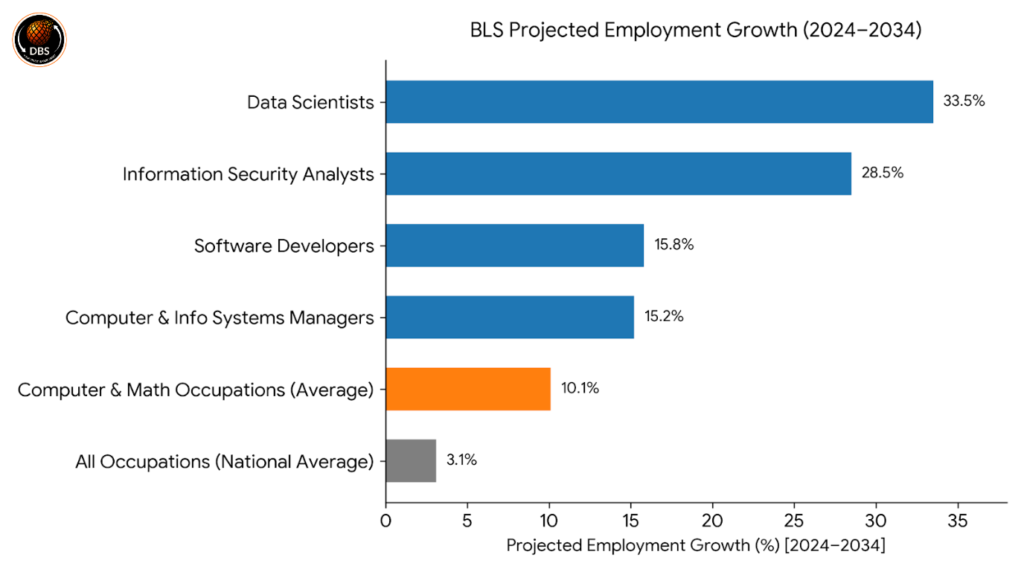
The U.S. Bureau of Labor Statistics, for example, currently projects software developer employment to grow by 15.8% between 2024 and 2034, adding more than 267,000 jobs. Information security analysts are projected to grow even faster, at 28.5%.
This does not mean every IT worker is protected.
It means the market is changing rather than simply disappearing.
A useful way to think about AI is:
AI may replace some tasks before it replaces entire professions.
For example, an analyst may use AI to prepare a first version of a report.
A tester may use AI to generate test scenarios.
A developer may use AI to produce routine code.
A support professional may use AI to identify possible causes of an issue.
The professional still needs to understand the output, check whether it is correct and decide what should happen next.
That human responsibility remains important.
The World Economic Forum also expects both technology and human skills to remain important, including analytical thinking, collaboration, resilience and creative thinking.
So the better question is not:
“Will AI replace IT?”
Ask:
“Which IT skills will become less valuable, and which will become more valuable because of AI?”
Which IT Jobs Are Most Exposed to AI?
AI exposure is not identical across every IT role.
Jobs involving highly repetitive, predictable and rule-based tasks are generally more exposed to automation.
This does not automatically mean those jobs will disappear.
Their responsibilities may simply change.
Repetitive and Rule-Based IT Tasks
Tasks with clear inputs, predictable processes and repeatable outputs are easier for software to automate.
Examples can include:
- Basic data processing
- Routine report generation
- Simple documentation
- Repetitive testing activities
- Basic content generation
- Standard troubleshooting steps
- Repetitive administrative work
- Simple code generation
The risk increases when a person’s entire job depends on performing these tasks manually.
That is why learning only one repetitive process can be risky.
A stronger approach is to understand why the process exists, what business problem it solves and how technology supports it.
This gives the worker more value than simply completing the task.
Entry-Level Work Is More Likely to Change
Entry-level professionals should pay close attention to this shift.
Many traditional beginner tasks are precisely the activities AI tools can accelerate.
That could change how companies structure junior roles.
A new employee may be expected to produce more with fewer manual steps.
This does not mean freshers have no future.
It means beginners need stronger foundations.
Someone who understands business requirements, basic databases, IT processes, documentation, communication and AI-assisted workflows can offer more than someone who knows only one repetitive task.
What AI Is Actually Changing in IT Careers
AI is changing the definition of productivity.
Previously, an employee might spend hours completing a task manually.
Today, an AI tool may complete the first version in minutes.
The professional’s role then shifts toward reviewing, correcting, improving and applying the result.
This creates a different kind of workplace advantage.
The most valuable employee may not be the person who can perform every task manually.
It may be the person who knows:
what to ask, what to verify and what to do with the result.
The World Economic Forum reports that 39% of workers’ existing skill sets are expected to be transformed or become outdated between 2025 and 2030.
That is an important message for anyone planning a career switch.
Your first skill set does not have to remain your final skill set.
From Doing Tasks to Managing AI-Assisted Work
Imagine a Business Analyst receiving a large amount of customer feedback.
AI can help summarize thousands of responses.
But someone still needs to determine:
- What is the actual business problem?
- Which findings matter?
- Are the conclusions accurate?
- What should the company change?
- How should the requirement be communicated to the technical team?
The same principle applies across IT.
AI can increase speed.
Professionals still provide context and accountability.
This is why learning to work with AI can be more useful than simply worrying about AI.
Human Skills Are Becoming More Important
Technical skills matter.
But they are not enough.
Communication, analytical thinking, problem-solving and business understanding become more valuable when AI handles more routine work.
The World Economic Forum specifically identifies analytical thinking as an important core skill while also highlighting resilience, flexibility, creative thinking and collaboration.
For a Non-IT professional, this can be good news.
You may already have valuable experience in areas such as customer interaction, operations, sales, finance or business processes.
The goal is to combine that experience with IT skills.
What Should Non-IT Professionals Actually Worry About?
The biggest mistake would be to interpret AI as:
“There are no IT jobs left.”
The more realistic concern is:
“The requirements for IT jobs are changing.”
A person who starts learning today but follows an outdated curriculum for years could enter the market with skills employers no longer prioritize.
That is a much more practical risk.
Learning Nothing While Job Requirements Change
Technology moves faster than traditional career planning.
Five years ago, some AI tools used in today’s workplaces were not part of everyday professional workflows.
That means career preparation cannot stop after completing one course or earning one certificate.
You need a habit of updating your skills.
For Non-IT professionals, the goal should not be learning every new technology.
Instead, build a foundation that can adapt.
Start with:
- Basic IT concepts
- Operating systems
- Databases
- Business analysis
- Cloud fundamentals
- Cybersecurity awareness
- AI tools
- Communication
- Problem-solving
Then add role-specific skills.
Competing With AI-Augmented Workers
The future competition may not simply be:
Human vs AI.
It may be:
Human using AI vs human not using AI.
Consider two employees.
Employee A spends four hours preparing a report manually.
Employee B uses AI to create a first draft, checks the information, improves it and spends the saved time solving higher-value problems.
If both produce accurate results, Employee B may have a productivity advantage.
This is why AI literacy is becoming a career skill.
You do not need to become an AI engineer.
You need to understand where AI can help you work faster and where human judgment is still required.
Is It Still Worth Switching From Non-IT to IT?
Yes, but the decision should be based on the role you want to build toward.
IT is not one job.
It includes software development, cybersecurity, cloud operations, business analysis, quality assurance, technical support, data-related roles, project management and many other career paths.
The World Economic Forum continues to list software and application developers among the fastest-growing roles globally, while technology-related skills are expected to increase in importance.
This means a Non-IT professional does not necessarily need to become a programmer.
Why IT Still Has Career Opportunities
Technology continues to spread across industries.
Banks need technology.
Hospitals need technology.
Retail companies need technology.
Manufacturing companies need technology.
Education, logistics, finance and professional services increasingly depend on digital systems.
As companies adopt more technology, they need people who understand both technology and business requirements.
That creates opportunities beyond traditional programming.
The U.S. Bureau of Labor Statistics also projects strong growth for several technology occupations, including software developers and information security analysts.
Why Non-Coding IT Roles Matter
Not every IT role requires the same level of programming.
Depending on the position, professionals can work in areas such as:
- Business Analysis
- IT Support
- Quality Assurance
- IT Project Coordination
- Cloud Support
- Cybersecurity operations
- Data analysis
- Systems and operations
- Technical documentation
The important point is not to assume “non-coding” means “no technical learning.”
You still need to understand technology.
You simply may not need to become a full-time programmer.
For someone moving from banking, sales, BPO, finance or operations, this can provide a practical bridge into technology.
Which Skills Should Non-IT Professionals Learn?
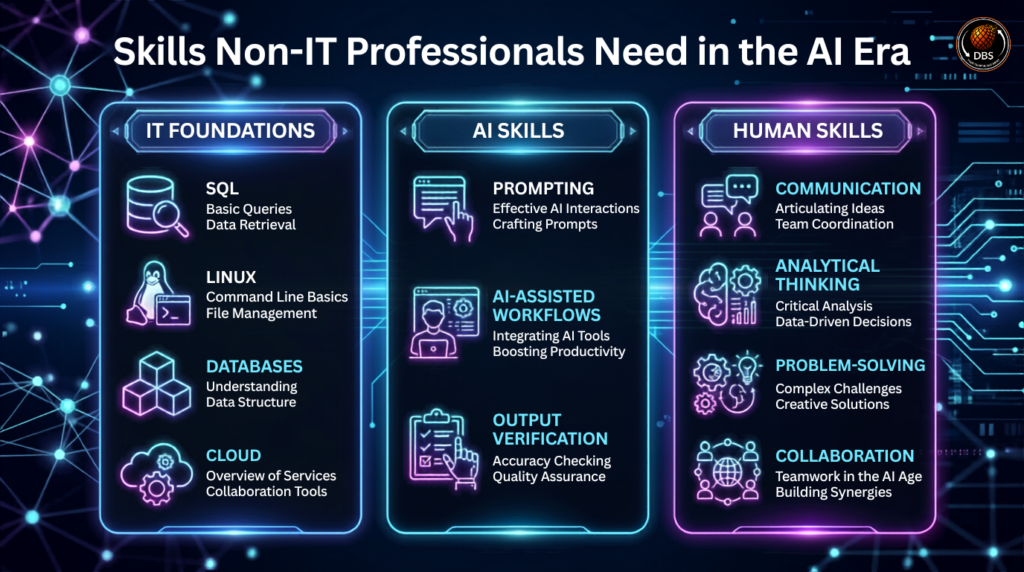
A strong IT career foundation should combine technical knowledge, AI literacy and human skills.
Technical Foundations
Start with concepts that help you understand how IT systems work.
Depending on your target role, this could include:
- Linux and Unix fundamentals
- SQL
- Databases
- NoSQL concepts
- Networking basics
- Cloud fundamentals
- Business Analysis
- Software development life cycle
- Testing concepts
- IT service management
You do not need to learn everything simultaneously.
Choose a target role first.
Then learn the skills that support that role.
AI Literacy
AI literacy does not mean building AI models.
For most professionals, it means knowing how to:
- Write useful prompts
- Verify AI-generated information
- Automate repetitive tasks
- Analyze AI output
- Use AI responsibly
- Protect confidential information
- Identify when human judgment is necessary
The goal is simple:
Use AI as a productivity tool without becoming dependent on it.
Communication and Business Skills
Technical knowledge gets you only part of the way.
IT professionals often need to explain problems, document requirements, communicate with teams and understand business priorities.
This is particularly important for roles such as Business Analyst, Project Coordinator, QA and IT support.
A Non-IT professional may already have experience communicating with customers, handling business processes or solving operational problems.
That experience can become an advantage when combined with technology skills.
How to Prepare for an AI-Driven IT Career
If you are currently working in a Non-IT field, do not start by trying to learn everything about AI.
Start with your target career.
Step 1: Choose a Role
Pick one direction.
For example:
Business Analyst → business requirements, SQL, documentation and process analysis.
IT Support → operating systems, networking, troubleshooting and cloud fundamentals.
QA → testing concepts, test cases, defect tracking and automation awareness.
Data Analyst → SQL, spreadsheets, data visualization and analytics.
Step 2: Build Technical Foundations
Learn the technology behind your chosen role.
Focus on practical understanding rather than collecting certificates.
Step 3: Add AI to Your Workflow
Once you understand the basics, learn how AI can improve your daily work.
For example:
- Generate a first draft of documentation
- Summarize information
- Create test scenarios
- Analyze structured data
- Prepare interview questions
- Improve communication drafts
Always verify important outputs.
Step 4: Build Proof of Your Skills
Employers need evidence that you can perform the work.
Create practical projects.
Document your process.
Build sample requirements, SQL queries, test cases, dashboards or project documentation depending on your target role.
Step 5: Prepare for Interviews
A career switch requires more than technical knowledge.
Be ready to explain:
- Why you are moving from Non-IT to IT
- What transferable skills you bring
- What you have learned
- What projects you have completed
- How you use AI responsibly
- Why you selected your target role
Your previous career is not necessarily something you need to hide.
It can become part of your professional story.
Final Takeaway
AI will change IT jobs.
Some tasks will disappear.
Some jobs will shrink.
New responsibilities and roles will also emerge.
Current employment projections already show that several technology occupations are expected to grow despite rapid AI adoption.
For Non-IT professionals, the biggest mistake is not entering IT because AI exists.
The bigger mistake is entering IT without understanding how the industry is changing.
You do not need to predict exactly what technology will look like five years from now.
You need a strong foundation, a clear career direction and the ability to keep learning.
AI may change the way IT professionals work.
The professionals who learn how to work with that change can remain valuable.
FAQs
Will AI replace IT jobs completely?
No. AI can automate specific tasks, but current employment projections still show growth in several technology occupations. The impact will vary by role, industry and task.
Will AI replace software developers?
AI will automate parts of software development, but software development itself is not expected to disappear. The U.S. Bureau of Labor Statistics projects software developer employment to grow significantly through 2034.
Should I switch from Non-IT to IT in 2026?
Yes, if you choose a suitable IT role and prepare for current market requirements. Focus on practical skills, AI literacy, communication and role-specific knowledge.
Can Non-IT professionals get IT jobs without coding?
Yes. Some IT roles have limited coding requirements. Business Analysis, IT support, QA, project coordination and certain operations roles can be alternatives, although each role has its own technical requirements.
What skills should I learn for an IT career in the AI era?
Start with the fundamentals relevant to your target role. Useful areas can include SQL, Linux, databases, cloud fundamentals, cybersecurity awareness, business analysis, AI literacy, communication and problem-solving.
Is AI a threat to freshers?
AI may reduce some repetitive entry-level tasks, making strong foundations and practical skills more important. Freshers should learn to use AI as a work tool while developing skills AI cannot reliably replace on its own, such as judgment, communication and business understanding.
How Digital Business Solutions Can Help Non-IT Professionals
Digital Business Solutions IT helps Non-IT professionals build the practical foundation needed to move into IT with greater clarity and confidence. Instead of focusing only on theory, the learning approach combines IT fundamentals, practical training and interview preparation. Learners can build knowledge in areas such as Linux, Unix, SQL, NoSQL and Business Analysis without needing a technical degree or a programming-heavy background.
The program is designed around a structured three-month learning journey, including practical training followed by focused interview preparation. Live sessions, recorded lectures, Q&A support, mock tests, communication sessions, mock interviews and interview practice help learners understand both the technical and professional side of an IT role.
For professionals concerned about AI, the focus is not simply on learning today’s tools. It is about developing adaptable IT skills, understanding workplace processes and learning how technology is used to solve business problems.
This makes the transition from Non-IT to IT more structured and practical.
Take the first step toward your IT career today.
Digital Business Solutions IT — Helping Non-IT Professionals Build Their Future in IT.
Book your free career consultation: https://forms.gle/spZqzEs2WGxepktg6
Watch real stories and career tips on our podcast: https://youtu.be/xlrOIaZTwWI
Follow Digital Business Solutions IT for weekly career tips:
- Instagram: @official_biplob_mandal
- LinkedIn: Biplob Mandal
Call us: +91 9307867881 / +91 7558759407
Email: contactus@digitalbusinesssolutionsforyou.com
Visit us: Office No. 412, 4th Floor, City Space, Digital Business Solutions IT, Pune Nagar Rd, above Aakash Eye Clinic, Viman Nagar, Pune, Maharashtra 411014
- BPO to IT: How to Change Career from BPO to IT Jobs
- How long does it actually take to switch from Non-IT to IT?
- Best Cities in India for a Non-IT to IT Career Switch (2026)
- SQL for Beginners: The One Skill That Opens IT Analyst Jobs
- What i wish I knew before switching from Non-IT to IT
- Top 10 Interview Questions for Non-IT to IT Career Switchers (and How to Answer Them)
- How to Write an IT Resume When You Have Zero IT Experience
·
