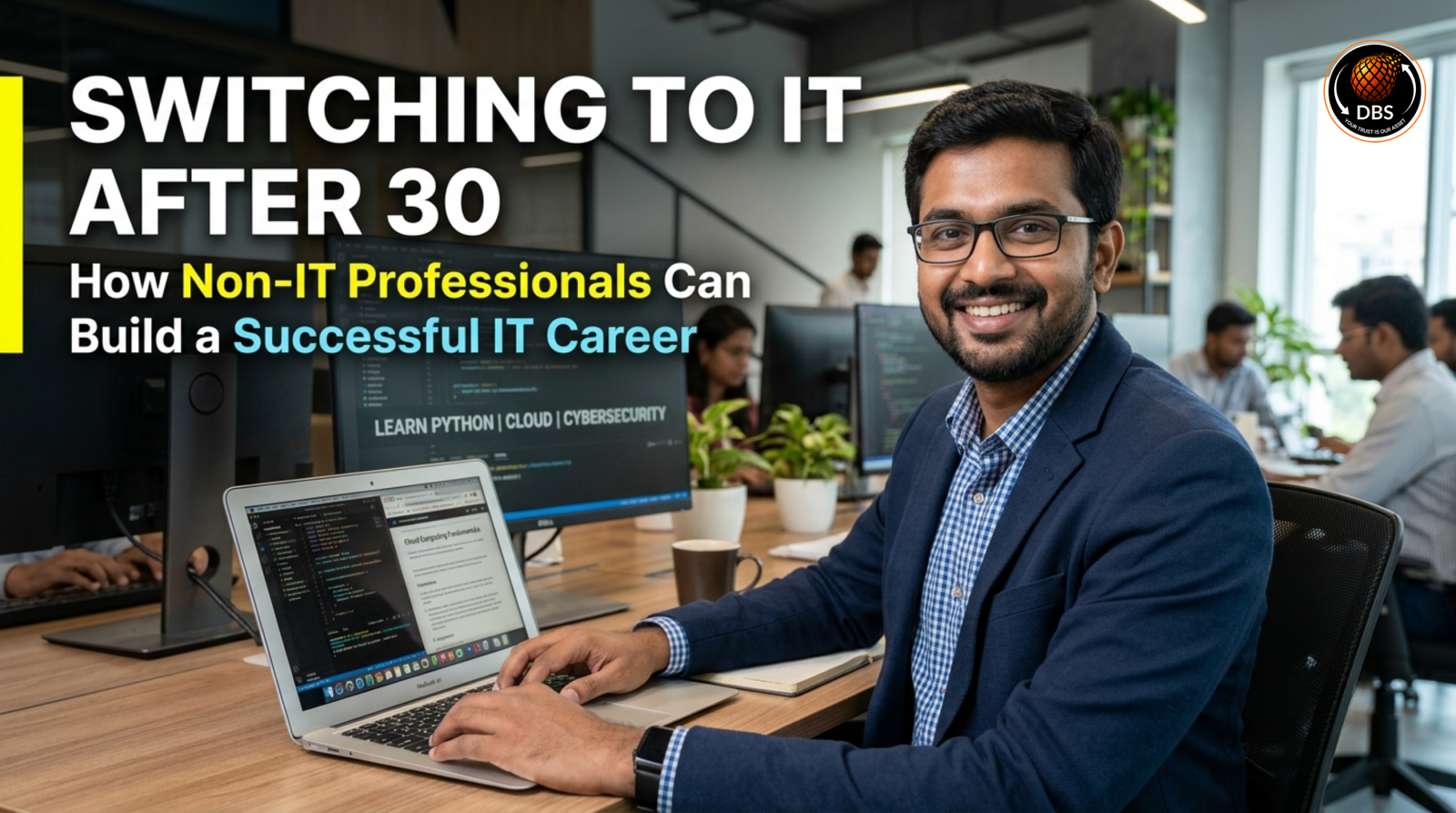
Switching to IT After 30: How Non-IT Professionals Can Build a Successful IT Career
I’m 30+ and Want to Switch to IT — Is It Too Late?
No. It is not too late to switch to IT after 30.
In fact, being 30+ can give you an advantage that many fresh graduates do not have: work experience, professional maturity, communication skills, business understanding, problem-solving ability, and experience dealing with people and pressure.
The idea that an IT career is only for people who started coding at 20 is outdated. The technology industry has expanded far beyond traditional software development. Today, there are opportunities across Business Analysis, Data Analysis, IT Operations, Application Support, Quality Assurance, Project Coordination, Technical Support, Database-related roles, and other technology-driven functions.
For professionals from B.Com, BBA, BA, banking, sales, customer service, BPO, administration, operations, or other non-IT backgrounds, the right strategy is not necessarily to forget everything they have learned and start from zero.
Instead, the smarter approach is to combine existing non-IT skills with relevant IT skills.
Why Switching to IT After 30 Is Still Possible
A career switch at 30, 35, or even later is not automatically a disadvantage.
At this stage, professionals often understand the workplace better than someone entering their first job. They may already know how to communicate with managers, handle deadlines, understand customers, work in teams, prepare reports, analyze problems, and take responsibility.
These skills have significant value in IT.
The key is understanding that IT is not one single career.
When people hear “IT,” they often immediately think about programming, software development, Python, Java, or complex coding.
But the technology industry includes many roles where coding is not the primary requirement.
For example, a professional with strong communication and business knowledge may explore Business Analyst roles. Someone comfortable with numbers, reports, and data may explore Data Analyst-related opportunities. A person with operations experience may find technology-enabled operations or IT support environments more relevant.
The objective should be to identify the intersection between:
Your existing experience + your transferable skills + the IT skills required for your target role.
Your Non-IT Skills Can Become Your IT Advantage
One of the biggest mistakes career switchers make is assuming that their previous career has no value.
It does.
Suppose someone has five years of experience in banking.
They may already understand:
- Customer requirements
- Financial processes
- Documentation
- Business workflows
- Compliance
- Reporting
- Problem-solving
- Communication
- Team coordination
Now imagine adding relevant IT and analytical skills to that experience.
The professional is no longer simply a beginner.
They can potentially position themselves as someone who understands both business and technology.
That combination is particularly relevant to roles where technology is used to solve business problems.
Similarly, someone from sales may bring:
- Communication
- Negotiation
- Customer understanding
- Target management
- Relationship management
- Presentation skills
A BPO professional may bring:
- Customer handling
- Process knowledge
- Communication
- Escalation management
- Documentation
- Process discipline
A commerce graduate may bring:
- Numbers
- Accounting concepts
- Business understanding
- Reporting
- Analytical thinking
These skills should not be thrown away when moving into IT.
They should become part of the career-switch strategy.
You Don’t Have to Start Your Career From Zero
This is one of the most important ideas for professionals considering a non-IT to IT career switch after 30.
Starting a new career does not necessarily mean starting your professional life from zero.
Your designation may change.
Your industry may change.
Your technical skill set may change.
But your professional experience, communication ability, discipline, and understanding of workplace environments remain valuable.
Instead of thinking:
“I have to become a completely different person to enter IT.”
Think:
“How can I add technology skills to the experience I already have?”
This shift in mindset can make the transition much more realistic.
What IT Skills Should You Learn After 30?
The answer depends on the role you want.
A career switcher does not need to learn every technology available.
Trying to learn everything can create confusion and delay.
A better approach is to select a specific career direction and build the skills associated with it.
For example, professionals targeting Business Analyst-oriented roles may benefit from understanding:
- Business requirements
- Requirement gathering
- Process analysis
- Documentation
- SQL fundamentals
- Linux and Unix fundamentals
- Data interpretation
- Communication
- Problem-solving
- Business processes
Professionals interested in Data Analyst-oriented roles may explore skills such as:
- SQL
- Excel
- Data analysis
- Reporting
- Data visualization
- Business understanding
- Analytical thinking
Professionals interested in IT operations or support-oriented environments may need exposure to:
- Linux
- Unix
- Databases
- SQL
- Troubleshooting concepts
- IT processes
- Application environments
The important point is role-based learning rather than random learning.
Why Learning Linux, Unix and SQL Can Help Non-IT Professionals
Many people hear words such as Linux, Unix, and SQL and immediately assume they require advanced programming knowledge.
That assumption can discourage potential career switchers.
In reality, these technologies are used across many IT environments, and professionals can learn their practical concepts according to the requirements of their target roles.
SQL, for example, is used to interact with and retrieve information from databases. Understanding how data is stored, queried, filtered, and analyzed can be valuable across multiple technology-related roles.
Linux and Unix are widely used operating-system environments in enterprise technology and server environments.
For someone transitioning from a non-IT background, the goal is not to memorize complicated commands without understanding them.
The goal is to develop practical IT awareness and job-relevant skills.
What About Age? Can Companies Hire Someone Over 30?
Age can be a concern for career switchers, but it should not become a reason to stop preparing.
Recruitment decisions depend on many factors, including:
- Relevant skills
- Experience
- Communication
- Role requirements
- Interview performance
- Business knowledge
- Practical understanding
- Organization-specific hiring requirements
A 30+ professional should therefore focus on creating a credible career narrative.
Instead of presenting the transition as:
“I have no IT experience.”
The career story can focus on:
“I have professional experience, transferable skills, and have now developed relevant IT capabilities to move into a technology-oriented role.”
That is a much stronger positioning strategy.
The Biggest Challenge Is Often Not Age — It Is Strategy
Many career switchers spend months collecting certificates without developing practical capability.
They learn one technology today, another tomorrow, and another the following week.
Eventually, they have several certificates but still cannot confidently answer:
“What IT role are you preparing for?”
A successful transition requires clarity.
Start with the destination.
Step 1: Identify Your Existing Strengths
Ask:
- What did I do in my previous job?
- What problems did I solve?
- What tools did I use?
- Was I good at communication?
- Did I work with customers?
- Did I work with numbers?
- Did I prepare reports?
- Did I coordinate teams?
- Did I analyze processes?
Step 2: Choose an IT Direction
Do not attempt to become an expert in every technology.
Choose a realistic role aligned with your background.
Step 3: Build Relevant Skills
Learn the technologies and concepts associated with that role.
Step 4: Practice
Knowledge becomes much more useful when it is applied.
Work on exercises, scenarios, practical questions, mock interviews, and real-world problem-solving.
Step 5: Reposition Your Profile
Your resume and LinkedIn profile should communicate a clear career story.
Your previous experience should not disappear.
Instead, show how your existing professional strengths complement your new IT skills.
Can a Non-IT Graduate Move Into IT?
Yes.
A BA, B.Com, BBA, M.Tech, B.Tech, or other educational background does not automatically determine the entire future of a person’s career.
What matters is whether the candidate can demonstrate relevant knowledge, skills, practical understanding, communication, and suitability for the target role.
For a non-IT graduate, the transition may require additional preparation because they may not have studied technology formally.
But that is a learning challenge—not necessarily a permanent barrier.
The important question is not:
“Did I study IT from the beginning?”
The better question is:
“What skills do I need now to become suitable for the IT role I want?”
How Digital Business Solutions IT Supports Non-IT to IT Career Transitions
At Digital Business Solutions IT, the focus is on helping non-IT professionals understand job-relevant IT concepts and build a structured path toward technology-oriented careers.
The learning approach covers areas such as Linux, Unix, SQL, Business Analysis and other IT-related concepts, with an emphasis on practical understanding rather than simply collecting certificates.
The program is designed around a structured learning journey that includes live learning, recorded lectures, mock tests, Q&A sessions, group practice, communication development, and interview preparation.
The course structure is designed to help learners build their knowledge and then spend dedicated time on revision and end-to-end interview preparation.
For professionals who are worried about starting late, this structured approach can help replace uncertainty with a clearer learning roadmap.
Your Previous Career Can Actually Help You in IT
Consider two candidates.
Candidate A
A fresh graduate with limited professional experience.
Candidate B
A 32-year-old professional with several years of experience in operations, sales, banking, BPO, finance, or customer service who has now developed relevant IT skills.
Candidate B may already understand:
deadlines + teamwork + communication + customers + business processes + workplace expectations.
When combined with the right IT skills, that previous experience can become part of the candidate’s professional advantage.
This is why a career switch should not always be viewed as starting over.
It can be viewed as building on what already exists.
A Practical 90-Day Mindset for a Career Switch
A career transition becomes easier to manage when broken into smaller stages.
First 30 Days: Build the Foundation
Understand the basics of your selected IT domain.
Focus on concepts instead of trying to memorize everything.
Next 30 Days: Practice
Apply your knowledge through exercises, scenarios, questions, and practical assignments.
Start identifying areas where you are still weak.
Final 30 Days: Interview Preparation
Work on:
- Resume positioning
- Interview questions
- Technical fundamentals
- Communication
- Mock interviews
- Practical scenarios
- Explaining your previous experience
- Explaining your career transition
The objective is to move from:
“I am interested in IT.”
to:
“I understand the role, I have developed relevant skills, and I can explain how my previous experience adds value.”
What Should You Avoid When Switching to IT After 30?
Don’t Learn Everything
The IT industry is enormous. Trying to master every technology will slow you down.
Don’t Hide Your Previous Experience
Your previous career can be valuable. Learn how to connect it with your new direction.
Don’t Depend Only on Certificates
Certificates can support learning, but practical knowledge and the ability to demonstrate your skills matter.
Don’t Ignore Communication
Technology professionals still work with people. Communication, documentation, collaboration, and problem-solving remain important.
Don’t Compare Your Timeline With Someone Else’s
A 22-year-old starting in IT and a 32-year-old switching careers are not starting from the same place.
Your journey includes experiences they may not have.
So, Is 30 Too Late to Switch to IT?
Absolutely not.
Thirty is not a deadline for learning.
Thirty-five is not a deadline for changing careers.
Your previous career is not wasted time.
Your non-IT background is not automatically a disadvantage.
The real opportunity lies in combining what you already know with what the technology industry requires.
Your experience can become your foundation. Your new IT skills can become your next step.
If you are 30+ and considering a non-IT to IT career switch, don’t ask only:
“Am I too old?”
Ask:
“Which IT role fits my existing skills, what do I need to learn, and how can I become job-ready?”
That question leads to action.
At Digital Business Solutions IT, the focus is on helping professionals make that transition through structured learning, practical IT concepts, practice, and interview preparation.
You don’t necessarily need to erase your past to build an IT career. You can use your past as part of your next career.
Ready to Explore Your Non-IT to IT Career Path?
Start by identifying your existing strengths, selecting a suitable IT direction, and building the skills required for that role.
Your career does not have an expiry date at 30.
Sometimes, 30 is simply the age when you become clear about where you want to go next.
Take the first step toward your IT career today.
Digital Business Solutions IT — Helping Non-IT Professionals Build Their Future in IT.
Book your free career consultation: https://forms.gle/spZqzEs2WGxepktg6
Watch real stories and career tips on our podcast: https://youtu.be/xlrOIaZTwWI
Follow Digital Business Solutions IT for weekly career tips:
- Instagram: @official_biplob_mandal
- LinkedIn: Biplob Mandal
Call us: +91 9307867881 / +91 7558759407
Email: contactus@digitalbusinesssolutionsforyou.com
Visit us: Office No. 412, 4th Floor, City Space, Digital Business Solutions IT, Pune Nagar Rd, above Aakash Eye Clinic, Viman Nagar, Pune, Maharashtra 411014
- BPO to IT: How to Change Career from BPO to IT Jobs
- How long does it actually take to switch from Non-IT to IT?
- Best Cities in India for a Non-IT to IT Career Switch (2026)
- SQL for Beginners: The One Skill That Opens IT Analyst Jobs
- What i wish I knew before switching from Non-IT to IT
- Top 10 Interview Questions for Non-IT to IT Career Switchers (and How to Answer Them)
- How to Write an IT Resume When You Have Zero IT Experience