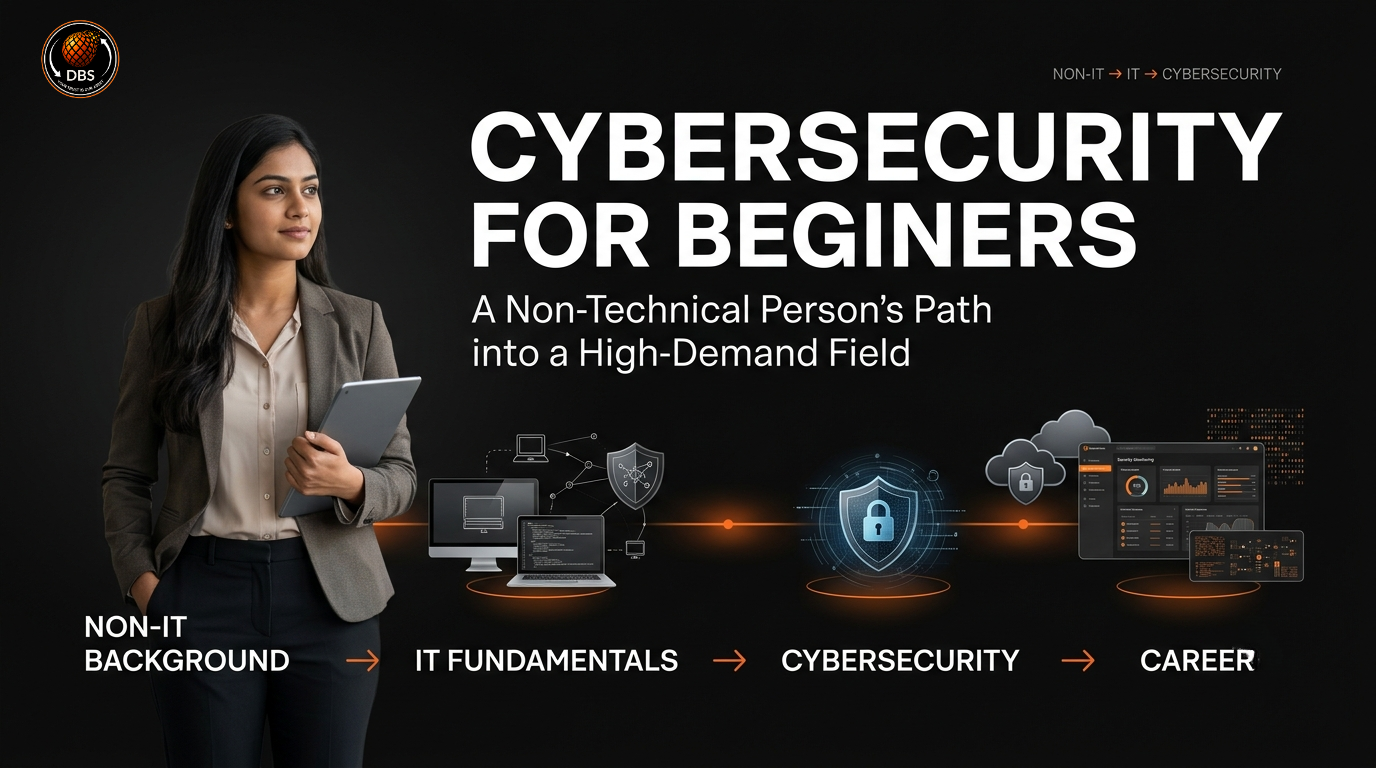
Cybersecurity for Beginners: A Non-Technical Person’s Path into a High-Demand Field
What Is Cybersecurity?
Cybersecurity is the practice of protecting computers, networks, applications, devices and data from unauthorized access, misuse, damage and disruption.
In simple terms, cybersecurity is about answering one question:
“How do we keep digital information and systems safe?”
Every modern organization depends on technology.
Banks process financial information.
Hospitals store patient records.
E-commerce companies manage customer accounts and payments.
Companies use email, cloud platforms, databases and internal applications every day.
That creates opportunities for cybercriminals.
Phishing can trick employees into giving away credentials.
Malware can damage systems or steal information.
Weak passwords can allow unauthorized access.
Unpatched software can contain security weaknesses.
Cybersecurity helps organizations reduce these risks.
The National Institute of Standards and Technology’s Cybersecurity Framework 2.0 organizes cybersecurity around six functions: Govern, Identify, Protect, Detect, Respond and Recover. The framework is designed for organizations of different sizes and levels of cybersecurity maturity.
For a beginner, however, you do not need to memorize frameworks on day one.
Start by understanding how technology works.
Then understand what can go wrong.
Finally, learn how organizations prevent, detect and respond to those problems.
That progression makes cybersecurity much easier to understand.
Cybersecurity in Simple Words
Think about your smartphone.
You use a password or biometric lock.
You receive security updates.
You may use two-factor authentication.
You avoid suspicious links.
These are basic cybersecurity practices.
Businesses use the same ideas at a much larger scale.
They protect employee accounts, customer information, applications, networks and business systems.
Cybersecurity is therefore not only about hackers and complex code.
It involves people, processes and technology.
That is important for beginners because cybersecurity contains many different types of work.
Some roles involve technical investigation.
Others involve policies, risk, compliance, documentation, security awareness or coordination.
CISA’s cybersecurity career resources also describe multiple cyber work roles and pathways, including options for people transitioning from non-cyber careers.
Why Cybersecurity Matters to Every Business
Cybersecurity is a business issue, not just an IT issue.
A security incident can affect operations, customer trust, finances and sensitive information.
Even basic protections matter.
NIST recommends practices such as multifactor authentication, strong passwords, backups, software updates and employee cybersecurity training.
CISA similarly highlights phishing awareness, strong passwords, MFA and software updates as fundamental security actions.
This creates demand for people who understand how security works.
It also creates opportunities beyond highly technical security engineering.
A person who can understand risks, document processes, communicate clearly and follow security procedures can contribute to a cybersecurity team.
Can a Non-Technical Person Start a Cybersecurity Career?
Yes.
But “non-technical” should not mean “I never need to learn technology.”
Cybersecurity still requires technical understanding.
The good news is that you can build that understanding step by step.
You do not need to become a programmer before learning cybersecurity.
You do not need to know every Linux command.
You do not need to understand advanced networking on your first day.
Your first goal should be to understand the foundations.
Learn what an IP address is.
Understand what a network does.
Learn how websites communicate with servers.
Understand usernames, passwords and authentication.
Learn what malware and phishing mean.
Then gradually move toward security tools and practical exercises.
CISA’s workforce-development programs specifically include pathways for people moving from non-cyber backgrounds and emphasize hands-on learning and entry-level training.
That is an important point for career changers.
Your previous career is not automatically irrelevant.
A person from banking may understand financial risk.
A customer-service professional may already know how to communicate with users.
A BPO professional may understand processes and ticket handling.
A sales professional may have strong communication and relationship skills.
These abilities can complement technical cybersecurity skills.
You Do Not Need to Know Everything on Day One
Many beginners make cybersecurity look harder than it is because they start with advanced topics.
Instead, build knowledge in layers.
Layer 1:
Computer basics.
Layer 2:
Networking basics.
Layer 3:
Operating systems.
Layer 4:
Security fundamentals.
Layer 5:
Practical security tools.
Layer 6:
Job-specific skills.
This approach prevents information overload.
The goal is not to learn every cybersecurity topic.
The goal is to develop enough knowledge to perform specific tasks confidently.
CyberSeek’s career resources show cybersecurity as a set of different pathways with different skills, credentials and roles rather than one single career.
Skills That Matter Beyond Coding
Coding can be useful in cybersecurity, but cybersecurity is much broader than programming.
Important beginner skills include:
- Problem-solving
- Logical thinking
- Attention to detail
- Basic networking
- Basic operating-system knowledge
- Documentation
- Communication
- Incident awareness
- Risk awareness
- Analytical thinking
Communication is especially important.
Security professionals often need to explain a technical problem to someone who is not technical.
For example:
“Your password is weak” is simple.
But explaining why password reuse creates risk and what the employee should do next requires communication.
That is why non-IT professionals should not automatically assume that their existing skills have no value.
The key is combining those skills with practical technology knowledge.
What Should Beginners Learn First?
A beginner-friendly cybersecurity path should begin with fundamentals rather than advanced hacking techniques.
Start with computers.
Then learn networks.
Then operating systems.
Then security concepts.
After that, begin practical exercises.
A simple foundation might include:
Computer hardware and software
Operating systems
Windows and Linux basics
Networking concepts
IP addresses
DNS
HTTP and HTTPS
Ports
Firewalls
Authentication
Authorization
Encryption
Phishing
Malware
Vulnerabilities
Security monitoring
Incident response
Backups
Access control
You do not need to master all of these immediately.
The objective is to understand what each concept means and why it matters.
NIST’s Cybersecurity Framework 2.0 is also useful as a high-level reference because it connects cybersecurity activities to broader organizational risk management.
Start With Computer and Network Basics
Before studying cybersecurity tools, understand the environment those tools protect.
Learn:
What is an operating system?
What is a server?
What is a network?
What is an IP address?
What is DNS?
What is a router?
What is a firewall?
What is a port?
What happens when you open a website?
For example, when you type a website address into your browser, several systems communicate behind the scenes.
Understanding that process makes later security concepts easier.
You can then understand where attacks may happen and where security controls can be applied.
This foundation is useful whether you eventually work in security operations, compliance, risk, cloud security or another cybersecurity area.
Learn Security Fundamentals
Once the basics are clear, move into security.
Start with common concepts:
Authentication means verifying who someone is.
Authorization determines what that person is allowed to access.
Encryption protects information by transforming it into a form that unauthorized users cannot easily read.
Phishing attempts to trick people into revealing information or taking unsafe actions.
Malware is malicious software designed to disrupt, damage or gain unauthorized access to systems.
A vulnerability is a weakness that could be exploited.
An incident is a security event that requires investigation or response.
These concepts appear repeatedly across cybersecurity roles.
CISA recommends basic protections such as MFA, strong passwords, phishing awareness and software updates because simple security controls can reduce common risks.
Build Practical Skills
Reading about cybersecurity is not enough.
You need practice.
A beginner can create a simple learning environment using safe labs and exercises.
For example:
- Practice Linux commands
- Explore basic network traffic
- Learn how logs work
- Identify suspicious emails
- Study sample security incidents
- Practice access-control concepts
- Create simple security checklists
- Work through beginner cybersecurity labs
Keep everything inside authorized learning environments.
The objective is to understand how systems behave and how security teams identify problems.
CISA’s career-development resources emphasize hands-on activities and realistic scenarios as part of cybersecurity workforce preparation.
Practical work also gives you something concrete to discuss during interviews.
Cybersecurity Career Options for Beginners
Cybersecurity is not one job.
There are different roles with different responsibilities.
Some are heavily technical.
Some combine technology with business processes.
Some focus on risk and compliance.
Some focus on monitoring and responding to security events.
The NICE Framework organizes cybersecurity work into work roles, tasks, knowledge and skills, helping employers and learners describe cybersecurity work more clearly.
For beginners, the important question is not:
“What is the best cybersecurity job?”
Instead ask:
“Which cybersecurity work matches my current skills and the skills I am willing to develop?”
Security Analyst
A security analyst may monitor security alerts, investigate suspicious activity, review logs and help respond to incidents.
The exact responsibilities vary between organizations.
A beginner interested in this path should build:
- Networking basics
- Linux and Windows fundamentals
- Security concepts
- Log analysis
- Incident-response basics
- Security monitoring concepts
You may also encounter tools such as SIEM platforms during your learning.
Do not focus on memorizing tool names.
Understand what the tools are used for.
The basic workflow is more important:
Something happens.
A security system generates information.
An analyst reviews it.
The analyst decides whether it is suspicious.
The issue is investigated.
Appropriate action is taken.
This logical process is a useful starting point for someone interested in security operations.
GRC and Compliance Roles
GRC stands for Governance, Risk and Compliance.
These roles can be a useful area for people who enjoy documentation, business processes, risk assessment and structured work.
GRC professionals may work with:
- Security policies
- Risk assessments
- Compliance requirements
- Internal controls
- Audits
- Security documentation
- Vendor risk
- Business processes
This does not mean GRC is non-technical.
You still need to understand cybersecurity concepts.
However, the work may involve less day-to-day technical investigation than some security operations roles.
NIST’s CSF 2.0 also emphasizes governance as one of its six core functions, showing how cybersecurity connects with organizational decision-making and risk management.
Security Support and Other Entry-Level Roles
Some people enter cybersecurity through adjacent IT roles.
For example:
IT support can teach troubleshooting.
System administration can build operating-system knowledge.
Network support can develop networking skills.
Cloud support can introduce cloud infrastructure.
From there, a person may move toward cybersecurity responsibilities.
This is one reason beginners should think about career pathways rather than only job titles.
CyberSeek provides career-pathway information covering entry-level through advanced cybersecurity roles and the skills associated with them.
The first role does not have to define your entire career.
The goal is to build transferable skills and move toward increasingly security-focused work.
How DBS IT Can Help You Move From Non-IT to IT
For someone starting from a non-IT background, the biggest challenge is often not motivation.
It is knowing what to learn first, what to practice and how to connect learning with an actual career path.
That is where DBS IT can support the transition.
DBS IT focuses on helping people from non-IT backgrounds understand the IT ecosystem and build practical, job-ready skills.
The approach can be especially useful for graduates and professionals coming from areas such as BPO, sales, banking, commerce or other non-technical backgrounds.
Instead of treating a career switch as one huge step, the process can be broken into smaller stages:
Understand IT.
Choose a direction.
Build foundational knowledge.
Practice practical skills.
Improve communication.
Prepare for interviews.
Build confidence.
Move toward relevant opportunities.
The objective is not to promise a job.
The objective is to help learners build the knowledge and practical foundation required to pursue IT opportunities.
Build the Right Foundation
A beginner can easily waste months jumping between random YouTube videos, certifications and tools.
A structured learning path reduces that confusion.
DBS IT can help learners understand:
- What cybersecurity actually involves
- Which foundational IT skills matter
- Which cybersecurity concepts to learn first
- How technical concepts connect to real jobs
- Which practical skills should be developed
- How to prepare for interviews
For a non-IT learner, context matters.
Learning “Linux” is different from understanding why Linux matters in IT.
Learning “networking” is different from understanding how networking knowledge helps in cybersecurity.
A structured approach connects the concept to the workplace.
That connection can make learning more meaningful and easier to apply.
Practice Skills Instead of Only Learning Theory
Watching videos can create familiarity.
Practice creates ability.
A useful cybersecurity learning path should include practical exercises.
Learners should work with realistic scenarios, documentation, troubleshooting tasks and safe security labs.
For example, instead of simply memorizing what phishing means, analyze sample messages and identify:
- Suspicious links
- Urgent language
- Fake sender information
- Requests for credentials
- Unusual attachments
Instead of memorizing Linux commands, use them to inspect files, permissions and processes.
Instead of memorizing networking definitions, connect them to actual system behavior.
This practical approach helps learners build confidence while creating examples
Digital Business Solutions IT — Helping Non-IT Professionals Build Their Future in IT.
Book your free career consultation: https://forms.gle/spZqzEs2WGxepktg6
Watch real stories and career tips on our podcast: https://youtu.be/xlrOIaZTwWI
Follow Digital Business Solutions IT for weekly career tips:
- Instagram: @official_biplob_mandal
- LinkedIn: Biplob Mandal
Call us: +91 9307867881 / +91 7558759407
Email: contactus@digitalbusinesssolutionsforyou.com
Visit us: Office No. 412, 4th Floor, City Space, Digital Business Solutions IT, Pune Nagar Rd, above Aakash Eye Clinic, Viman Nagar, Pune, Maharashtra 411014