

Salary Negotiation Tips: A Complete Guide to Get Paid Fairly
Salary negotiation is one of the most important conversations in the hiring process — yet most professionals approach it without understanding what actually determines an offer.
A common misconception is that salary negotiation simply means asking an employer to raise the number on an offer letter. In reality, it’s a structured conversation about professional value, market conditions, experience, responsibilities, and the employer’s compensation framework.
Whether you’re entering the job market for the first time, switching careers, or moving into a higher-level position, understanding these factors helps you approach salary discussions strategically — not emotionally.
What Determines Your Salary Offer?
Employers rarely decide compensation based on a single factor. Several variables shape the final package:
- Experience — Professionals with several years of relevant experience often have greater negotiating leverage, since they can point to real achievements and business impact.
- In-demand skills — Candidates with skills that are currently scarce in the market have more room to negotiate than those competing in a saturated talent pool.
- Job role — Different positions carry different compensation ranges based on responsibility, complexity, and business importance.
- Location — A role in a Tier 1 city often follows a different salary structure than the same role elsewhere, driven by local hiring markets and operating costs.
Salary Negotiation Is About Market Value, Not Demands
One of the strongest salary negotiation strategies is shifting the conversation from “I want a higher salary” to a more professional question:
What value does my experience and skill set bring to this specific role?
This reframing changes everything. A candidate with specialized technical knowledge, strong business understanding, or proven project experience can justify a stronger compensation ask — not because they’re demanding more, but because the evidence supports it.
The goal isn’t an unrealistic number. The goal is a compensation expectation backed by skills, experience, and market conditions.
How HR Evaluates Salary Expectations
HR teams balance several factors when discussing compensation, including:
- Current or previous compensation
- Relevant professional experience
- Required skills and job responsibilities
- Internal salary structures and budget
- Market compensation benchmarks
- Candidate availability and business needs
- Location of the role
This means salary negotiation is rarely an isolated decision — even a strong interview performance still has to fit within the organization’s broader salary framework. Understanding this helps you negotiate without treating the conversation as a personal disagreement.
HR vs. Operational Managers: Who Decides What
Another key part of understanding how to negotiate salary is knowing who’s involved in the process.
An operational manager typically evaluates whether you can perform the role and contribute to the team. HR, on the other hand, focuses more on compensation structures, internal equity, hiring budgets, and the overall employment package.
Since the person assessing your capability may not be the person deciding your compensation, it’s important to communicate your value clearly at every stage of the hiring process — not just the final salary discussion.
Why Location Affects Salary
Location plays a bigger role in compensation than many candidates realize. Organizations hiring for similar roles in a Tier 1 city often structure pay differently than those hiring elsewhere.
This isn’t a reflection of your professional worth — it reflects local talent availability, operating costs, business presence, and regional salary benchmarks. Researching the market where the job is actually based is a critical step before entering any negotiation.
Should You Reveal Your Expected Salary?
This is one of the most common points of uncertainty in interviews.
- Giving a number without research risks undervaluing yourself.
- Giving an unrealistic number without evidence can weaken your position.
A stronger approach: research the compensation range for the role, factor in your experience, skills, and location, and present a reasonable range — along with the reasoning behind it — instead of fixating on the highest possible figure.
Salary Negotiation Tips for Freshers
Freshers often assume they have no negotiating power because they lack professional experience. That’s not entirely true — negotiation for a fresher isn’t about demanding more money; it’s about understanding the complete offer.
Evaluate the full picture before accepting:
- Fixed and variable compensation
- Incentives and benefits
- Learning opportunities and training
- Career progression and growth potential
- Job responsibilities and work location
- Probation conditions
A slightly lower starting salary can sometimes be worth it for the exposure, mentorship, or career progression it provides — but only if you understand the complete structure first.
Salary Negotiation Tips for Experienced Professionals
Experienced professionals have more evidence to work with — measurable achievements, successful projects, leadership experience, and specialized skills.
Instead of saying: “I deserve a higher salary,”
try: “Based on my experience, relevant skills, and the expectations of this role, I believe this compensation range is appropriate.”
This keeps the conversation professional and evidence-based rather than emotional.
Common Salary Negotiation Mistakes to Avoid
- Negotiating without research — entering the conversation without knowing the market range.
- Focusing only on current salary — your past pay isn’t always an accurate measure of your value in a new role.
- Giving an unrealistic number — one that isn’t backed by skills, experience, or market data.
- Making salary the only priority — ignoring the complete career opportunity.
- Treating HR as an opponent — negotiation is a professional discussion, not a confrontation.
- Accepting without understanding the offer — always review the full compensation structure before saying yes.
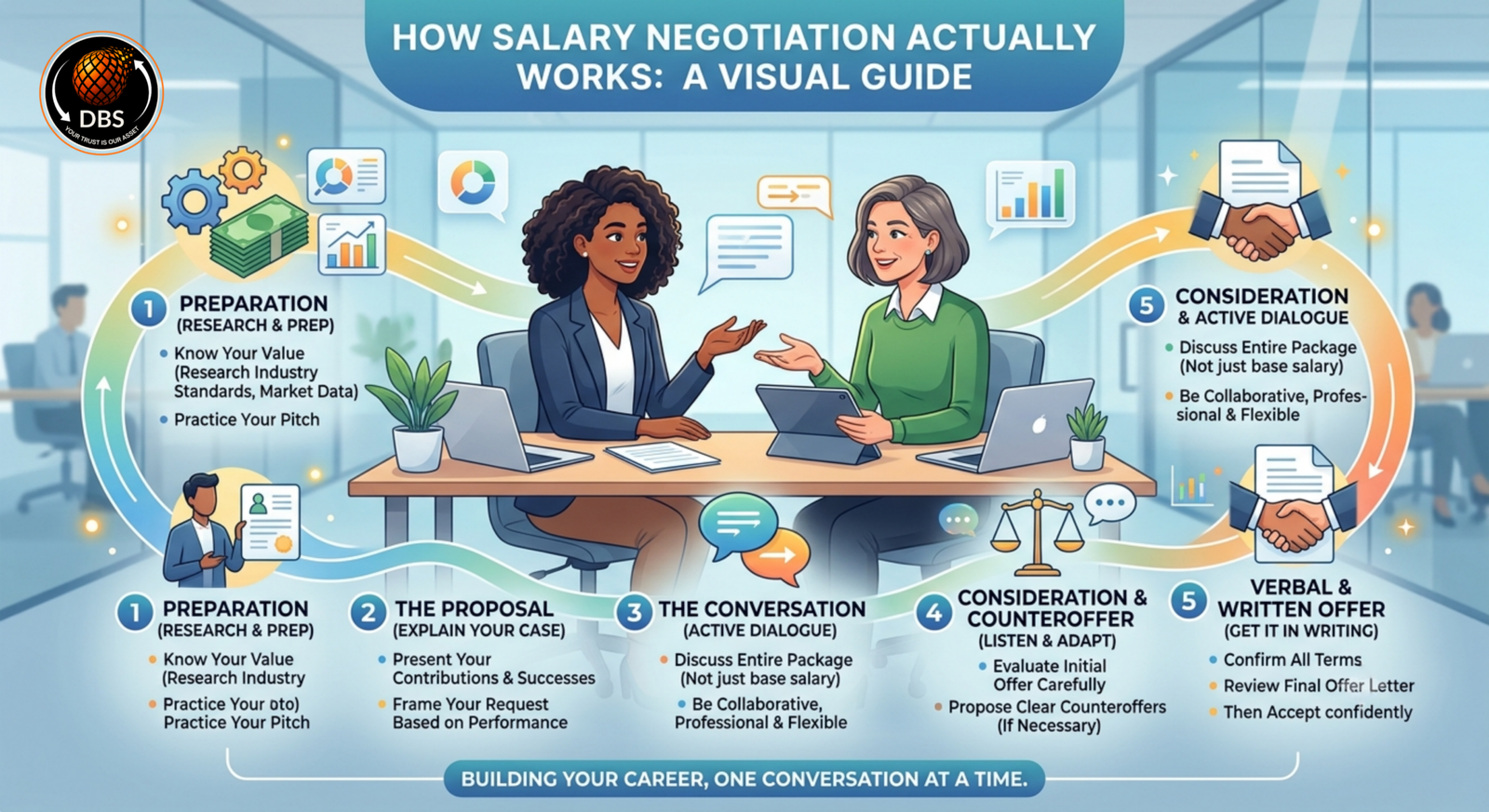
A Practical 5-Step Salary Negotiation Strategy
- Research the market — Understand the compensation range for your role, experience level, industry, and location.
- Evaluate your value — Identify the skills, experience, and achievements that make you relevant to the role.
- Define your target range — Set a realistic expectation instead of picking a random number.
- Communicate professionally — Present your expectations with evidence and confidence.
- Evaluate the complete offer — Weigh salary alongside benefits, growth, responsibilities, and long-term opportunity.
The Most Important Rule: Know Your Value
Effective salary negotiation starts long before the actual conversation. When you understand your skills, experience, market demand, and the value you bring to an organization, you can walk into compensation discussions with real confidence.
The objective isn’t to extract the highest possible number — it’s to reach a fair, informed agreement that reflects your professional value while staying realistic within the employer’s structure and the broader market.
Salary negotiation isn’t just a conversation about money. It’s a conversation about value, expectations, and career positioning — and mastering it puts you in control of your career trajectory.
FAQs
Q1: How do I know my market salary range? Research industry salary reports, job portals, and professional networks for roles similar to yours in experience level and location.
Q2: Should freshers negotiate their first salary? Yes — but the focus should be on understanding the complete offer (benefits, growth, training) rather than pushing for a higher number.
Q3: What’s the biggest mistake people make in salary negotiation? Entering the conversation without research and treating HR as an opponent instead of a partner in a professional discussion.
Book your free career consultation: https://forms.gle/spZqzEs2WGxepktg6
Watch real stories and career tips on our podcast: https://youtu.be/xlrOIaZTwWI
Follow Digital Business Solutions IT for weekly career tips:
- Instagram: @official_biplob_mandal
- LinkedIn: Biplob Mandal
Call us: +91 9307867881 / +91 7558759407
Email: contactus@digitalbusinesssolutionsforyou.com
Visit us: Office No. 412, 4th Floor, City Space, Digital Business Solutions IT, Pune Nagar Rd, above Aakash Eye Clinic, Viman Nagar, Pune, Maharashtra 411014