Career Comeback: How Housewives Can Start a Career in IT
A career break does not erase your ability to work.
For many women, stepping away from employment is a practical decision.
Marriage, pregnancy, childcare, elder care, relocation, family responsibilities, or personal circumstances can change career plans.
Years later, returning to work can feel difficult.
The job market may look different.
Technology may have changed.
Your previous skills may feel outdated.
You may also wonder whether employers will consider you after a long gap.
The good news is that a career comeback can be planned.
You do not need to restart by trying to learn everything about technology.
You need to identify a suitable career direction, develop relevant skills, create evidence that you can perform the work, and prepare for the hiring process.
Technology is also changing the type of skills employers value.
The World Economic Forum’s Future of Jobs Report 2025 identifies AI and big data, networks and cybersecurity, and technological literacy among the fastest-growing skill areas through 2030. Analytical thinking, resilience, flexibility, creative thinking, and lifelong learning are also expected to remain important.
That creates opportunities for people willing to learn.
This guide explains how a housewife can build a realistic path toward an IT career without assuming that everyone needs to become a programmer.
1. Can a Housewife Become an IT Professional?
Yes.
But the realistic answer is that becoming an IT professional requires preparation.
You may not need to start with advanced programming.
You may not need to spend years earning another degree.
You do need current, job-relevant skills.
IT is a large industry containing many different types of roles.
Some positions are highly technical.
Others involve business processes, support, analysis, documentation, testing, coordination, operations, systems, or communication.
That distinction matters for someone returning after a career break.
Your first goal should not be:
“I need to learn everything about IT.”
A better goal is:
“I need to become employable for one suitable IT role.”
This makes the process more manageable.
A career break also does not mean you have no professional value.
Running a household can involve planning, scheduling, budgeting, communication, problem-solving, negotiation, prioritisation, and managing multiple responsibilities.
These experiences should not be presented as a replacement for professional IT skills.
Instead, they can complement the skills you build during your career comeback.
The job market itself is changing.
The World Economic Forum reports that nearly 40% of job skills are expected to change by 2030, while employers continue to value both technology skills and human capabilities.
That means continuous learning is becoming normal across careers.
Your Career Break Does Not Define Your Future
A gap on your resume is a fact.
It is not a complete description of your ability.
The important question is what you have done recently to become work-ready.
For example, someone returning after five years could show:
- Completed an IT course
- Built practical projects
- Learned SQL or Linux fundamentals
- Practised business analysis
- Created a professional resume
- Improved communication skills
- Completed mock interviews
- Applied for suitable entry-level roles
This gives recruiters recent evidence.
Instead of trying to hide the gap, explain it clearly and move the conversation toward your current skills.
Choose a Role Before Choosing a Course
One common mistake is enrolling in a course because it is popular.
Start with the job.
Search for roles such as:
- IT Support
- Technical Support
- Business Analyst
- Quality Analyst
- Operations Analyst
- Data Analyst
- Project Coordinator
- Application Support
- IT Operations
Read several job descriptions.
Look for repeated requirements.
Then build your learning plan around those requirements.
This prevents unnecessary study and gives your career comeback a clear target.
2. Which IT Careers Are Suitable After a Career Break?
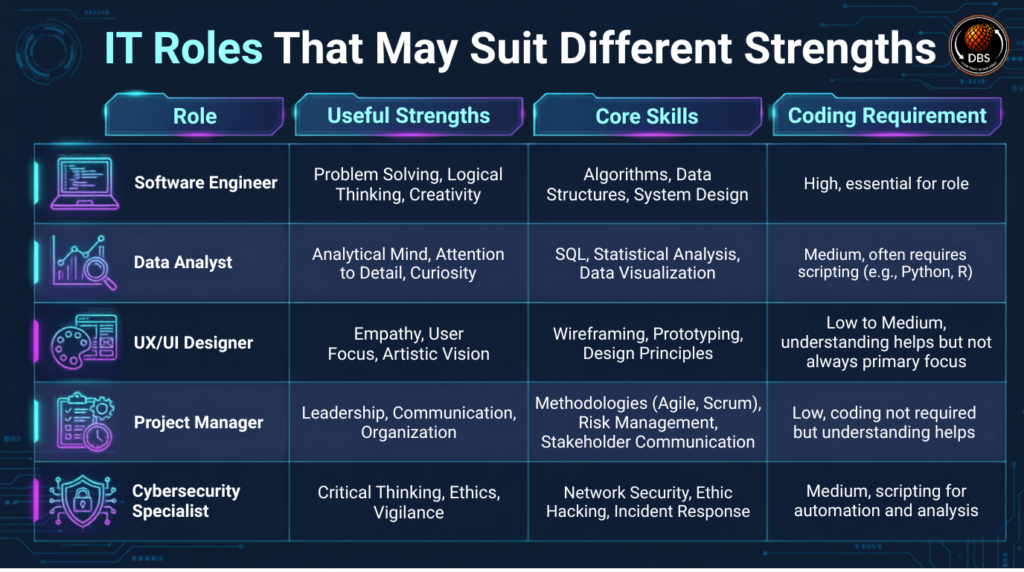
There is no single “best IT job” for every housewife.
Your previous education, interests, communication ability, learning time, and preferred work environment all matter.
Some people may prefer technical support.
Others may enjoy analysing business requirements.
Someone comfortable with numbers may prefer data-related work.
Someone with strong communication skills may fit support, coordination, or business-facing roles.
You also do not have to assume that IT means software development.
The technology sector includes many roles outside traditional coding-heavy development.
For example, Google describes its IT Support Certificate as preparation for introductory IT support work covering troubleshooting, networking, operating systems, system administration, and security, with no relevant experience required.
Google’s Data Analytics Certificate similarly states that no prior experience or degree is required and focuses on areas such as data analysis, problem-solving, and data storytelling.
These examples show why it is useful to look beyond the stereotype that every IT career begins with programming.
IT Support and Technical Support
IT support can be a practical entry point for people who enjoy solving problems and helping users.
Typical responsibilities can include:
- Troubleshooting computer issues
- Supporting operating systems
- Understanding networks
- Managing basic system issues
- Resolving user requests
- Documenting solutions
- Escalating complex problems
The work requires patience and structured thinking.
Communication is also important because support professionals regularly interact with people who may not understand technical terminology.
Business Analysis and Data-Related Roles
Business analysis can suit people who enjoy understanding problems, processes, requirements, and business needs.
A business analyst may work between business teams and technical teams.
Typical activities include:
- Understanding requirements
- Documenting processes
- Identifying business problems
- Preparing requirement documents
- Communicating with stakeholders
- Supporting solution development
Data-related roles are another option.
Entry-level data work may involve spreadsheets, SQL, dashboards, reporting, data cleaning, and basic analysis.
The right choice depends on your aptitude and the requirements of the roles you want to pursue.
3. What Skills Should You Learn Before Returning to IT?
You do not need to learn every technology.
You need a focused skill set that matches your target role.
Start with foundational digital skills.
Make sure you are comfortable with:
- Professional email
- Microsoft Office or equivalent productivity tools
- File management
- Online meetings
- Presentations
- Basic documentation
- Internet research
- Professional communication
Then move toward role-specific skills.
For an IT support path, this could include operating systems, networking fundamentals, troubleshooting, security basics, and system administration.
For business analysis, focus on requirements, process mapping, documentation, stakeholder communication, SQL basics, and business problem-solving.
For data analytics, consider spreadsheets, SQL, data cleaning, visualisation, and analytical thinking.
The World Economic Forum’s 2025 research highlights technological literacy, AI and big data, networks and cybersecurity, analytical thinking, creative thinking, resilience, and lifelong learning as important areas for the coming years.
The message is simple:
Learn technology, but also strengthen the human skills that help you use it effectively.
Build Skills in the Right Order
Do not jump between ten different courses.
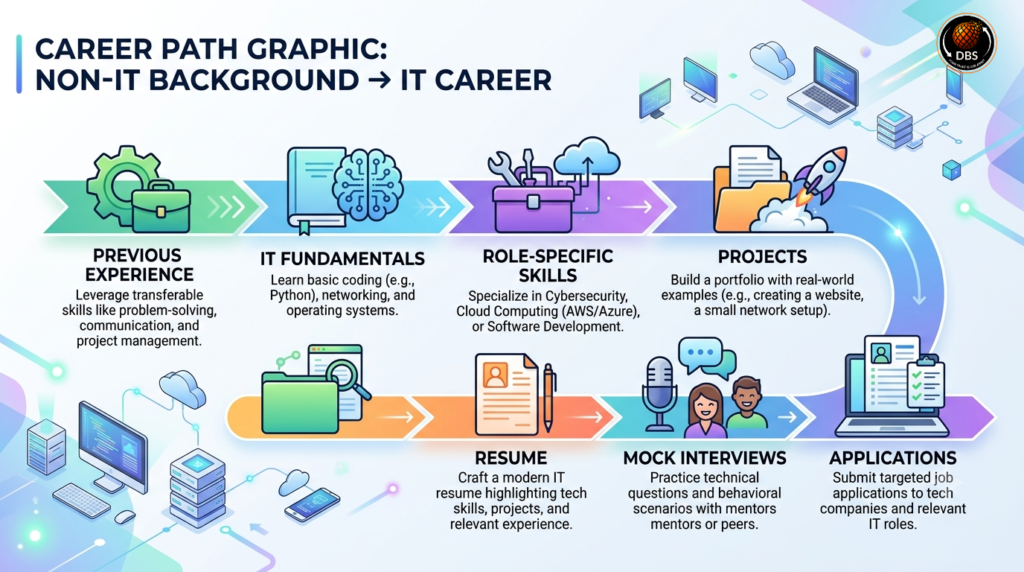
Use a progression such as:
- Digital fundamentals
- IT fundamentals
- Role-specific technical skills
- Practical projects
- Resume preparation
- Interview preparation
- Job applications
This creates measurable progress.
For example, someone targeting business analysis could learn:
- Business requirements
- Process mapping
- SQL basics
- Documentation
- Excel
- Stakeholder communication
- Interview case questions
Someone targeting IT support could focus on:
- Windows and Linux basics
- Networking
- Troubleshooting
- Operating systems
- Security fundamentals
- Ticketing concepts
- User communication
Do Not Collect Certificates Without Practice
Certificates can demonstrate learning.
They do not automatically demonstrate job readiness.
A stronger profile combines learning with evidence.
Create small projects.
Document what you did.
Explain the problem, your approach, the tools you used, and the result.
This gives you something concrete to discuss during interviews.
Google’s India-focused career certificate programmes, for example, describe their programmes as job-oriented and practice-based, reinforcing the value of learning that connects directly to workplace tasks.
4. How to Handle a Long Career Gap on Your Resume
Do not create an unnecessarily complicated explanation.
Be honest.
Be concise.
Then focus on what you are doing now.
A career gap can be presented professionally when the reason is clear and the current direction is strong.
For example:
“Career Break: 2020–2025. Took time away from full-time employment to manage family responsibilities. Since 2025, completed structured training in IT fundamentals, SQL, and business analysis and have been preparing for a return to the technology sector.”
The exact wording should reflect your situation.
Do not invent employment.
Do not add fake projects.
Do not create false experience.
Instead, build recent evidence through legitimate learning and projects.
Your resume should make your current capabilities easy to understand.
Place relevant skills near the top.
Include projects where appropriate.
Highlight measurable outcomes from previous employment if you have previous professional experience.
Avoid filling the resume with unrelated information.
Recruiters often spend limited time reviewing applications.
A clean structure helps them quickly identify your target role, skills, experience, education, and recent learning.
Explain Your Career Gap in Interviews
You may be asked:
“Why did you leave your previous job?”
“Why did you take such a long break?”
“Why are you returning now?”
Answer directly.
A strong answer has three parts:
- State the reason.
- Explain what changed.
- Show what you have done to prepare for work again.
For example:
“I took a career break to focus on family responsibilities. Now that my circumstances allow me to return to professional work, I have chosen to move toward IT. I have been developing relevant skills, completing practical projects, and preparing for interviews.”
Then stop.
Do not spend five minutes defending the decision.
Show That You Are Ready Now
The interviewer is usually more interested in your present ability than the number of years in your gap.
Be prepared to discuss:
- What you have learned
- Why you chose the role
- What projects you completed
- What tools you can use
- How you solve problems
- Why you want to return to work
- How you plan to continue learning
Your confidence should come from preparation rather than rehearsed claims.
5. How to Rebuild Confidence After Years Away From Work
Confidence often returns after action, not before it.
Waiting until you feel completely confident can delay your comeback.
Start with small professional tasks.
Create a LinkedIn profile.
Update your resume.
Complete one course.
Build one project.
Attend one professional session.
Speak to someone working in the field.
Practise answering interview questions.
Apply for a few suitable positions.
Each completed step reduces uncertainty.
You may initially compare yourself with people who have never taken a career break.
That comparison is rarely useful.
Your starting point is different.
Focus on measurable progress.
For example:
Week 1: Understand your target IT role.
Week 2: Start the required fundamentals.
Week 3–4: Practise daily.
Month 2: Build projects.
Month 3: Prepare your resume and interview answers.
After that: Apply, interview, review feedback, and improve.
The timeline will differ for every person.
The key is consistency.
Technology also changes quickly.
The World Economic Forum estimates that 39% of workers’ existing skill sets may be transformed or become outdated between 2025 and 2030.
That means even experienced professionals must keep learning.
A returning professional is not uniquely “behind” because she needs to update her skills.
Use Your Previous Experience
Do not assume your earlier career has no value.
If you worked in banking, healthcare, BPO, KPO, education, sales, administration, finance, or another field, you may already understand customers, processes, documentation, deadlines, communication, or business operations.
Those experiences can help you understand business problems.
The goal is to connect your previous experience with your new IT direction.
For example:
Banking experience + technology skills = potential financial technology or business-facing roles.
Healthcare experience + technology skills = potential healthcare technology roles.
Customer service experience + IT skills = potential technical support roles.
Operations experience + analytical skills = potential operations or business analysis roles.
This combination can make your career story more logical.
Build a Professional Routine
A career comeback becomes easier when learning becomes part of your routine.
Set aside a fixed daily period.
Even 60–90 focused minutes can create progress when used consistently.
A practical routine could include:
30 minutes: Learn a concept.
30 minutes: Practise.
15 minutes: Review notes.
15 minutes: Work on a project or interview question.
The exact schedule can change based on family responsibilities.
Consistency matters more than a perfect timetable.
6. How to Prepare for Your First IT Interview After a Career Break
Interview preparation should begin before you start receiving interview calls.
You need to prepare three areas:
Technical knowledge.
Professional communication.
Career-story answers.
Technical questions will depend on your target role.
For IT support, expect questions about operating systems, networks, troubleshooting, security, and user support.
For business analysis, prepare requirements, process analysis, documentation, stakeholder management, and basic technical concepts.
For data roles, prepare spreadsheets, SQL, data interpretation, and analytical thinking.
You should also practise explaining concepts in simple language.
Do not memorise answers word-for-word.
Understand the concept and explain it naturally.
The second area is communication.
Many candidates know the answer but struggle to explain it clearly.
Practise:
- Introducing yourself
- Explaining your career gap
- Describing your projects
- Explaining why you chose IT
- Discussing strengths and weaknesses
- Answering behavioural questions
- Asking relevant questions at the end of an interview
Mock interviews are useful because they expose gaps before the actual interview.
Prepare a Strong “Tell Me About Yourself” Answer
Your introduction should not begin with a detailed family history.
Keep it professional.
A simple structure is:
“Previously, I worked in [field]. I then took a career break because of [brief reason]. During my break, I decided to prepare for a return to professional work and developed skills in [relevant skills]. I am now looking for an opportunity in [target role], where I can apply my previous experience along with my new IT skills.”
Keep it focused.
The interviewer needs to understand where you came from, what changed, what you learned, and what role you want now.
Practise Real Workplace Situations
Do not prepare only textbook questions.
Practise situations such as:
- A user is unable to access a system.
- A business team gives unclear requirements.
- A report contains inconsistent data.
- A stakeholder changes requirements late.
- You do not know the answer to a technical question.
- You have multiple urgent tasks.
Employers want to understand how you think.
A structured answer is often more valuable than trying to sound highly technical.
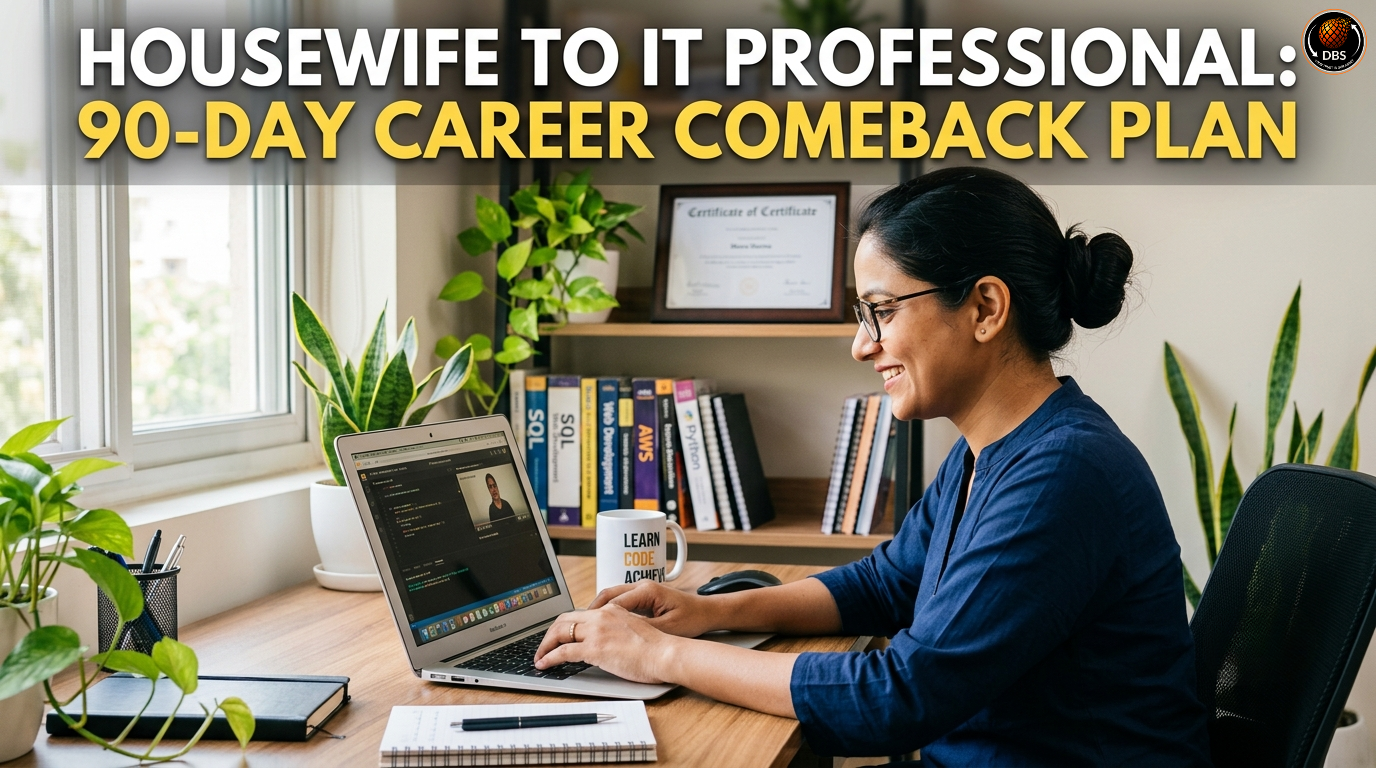
7. A Practical 90-Day Career Comeback Plan
A career comeback becomes easier when you divide it into stages.
The first 30 days should focus on direction and foundations.
Identify one target role.
Study job descriptions.
List the common skills.
Select a structured learning path.
Refresh your digital and professional basics.
Days 31–60 should focus on practice.
Work on projects.
Use the tools required for your target role.
Create examples of your work.
Start practising interview questions.
Update LinkedIn.
Prepare your resume.
Days 61–90 should focus on job readiness.
Conduct mock interviews.
Improve weak areas.
Start applying to relevant positions.
Track applications.
Review interview feedback.
Continue learning while applying.
Do not wait until you feel “100% ready.”
Job searches themselves provide useful feedback.
If applications receive no response, review your resume.
If interviews stop after technical rounds, review your technical preparation.
If interviews stop after HR discussions, improve communication or role alignment.
Your 90-Day Checklist
Days 1–30:
- Choose one IT career path
- Research job descriptions
- Identify required skills
- Start structured learning
- Establish a daily study routine
Days 31–60:
- Practise technical skills
- Build 1–2 practical projects
- Create or update LinkedIn
- Prepare your resume
- Start interview practice
Days 61–90:
- Complete mock interviews
- Refine your resume
- Apply for suitable roles
- Track applications
- Review interview feedback
- Continue skill development
The objective is not to become an IT expert in 90 days.
The objective is to move from uncertainty to a structured, job-focused preparation process.
Final Thoughts: Your Career Can Start Again
Becoming an IT professional after being a housewife is possible, but it should be approached as a career project rather than a quick transformation.
Choose one direction.
Learn the skills employers actually ask for.
Practise them.
Build evidence.
Prepare your resume.
Practise interviews.
Apply consistently.
Most importantly, do not treat your career break as the end of your professional identity.
The labour market is changing for everyone.
Technology skills are becoming more important, while analytical thinking, adaptability, communication, and lifelong learning continue to matter.
You do not need to compete by pretending that your past never happened.
You need to show what you can do now.
How Digital Business Solutions Can Help
Digital Business Solutions helps non-IT professionals, including women returning to work after a career break, build a practical path toward an IT career. Instead of expecting you to start with advanced coding or a technical degree, DBS focuses on job-relevant skills, practical training, and interview preparation. Learners can build knowledge in areas such as Linux, Unix, SQL, NoSQL, Business Analysis, and other IT fundamentals through structured training. The program combines practical learning with mock tests, communication sessions, mock interviews, live interview practice, and profile-building support. With live and recorded sessions and continued access to learning support, DBS aims to make the transition from a non-IT background to IT more structured and achievable. Whether you are restarting your career after marriage, motherhood, or another career break, the focus is on building current skills, improving interview readiness, and preparing for suitable IT opportunities.
Take the first step toward your IT career today.
Digital Business Solutions IT — Helping Non-IT Professionals Build Their Future in IT.
Book your free career consultation: https://forms.gle/spZqzEs2WGxepktg6
Watch real stories and career tips on our podcast: https://youtu.be/xlrOIaZTwWI
Follow Digital Business Solutions IT for weekly career tips:
- Instagram: @official_biplob_mandal
- LinkedIn: Biplob Mandal
Call us: +91 9307867881 / +91 7558759407
Email: contactus@digitalbusinesssolutionsforyou.com
Visit us: Office No. 412, 4th Floor, City Space, Digital Business Solutions IT, Pune Nagar Rd, above Aakash Eye Clinic, Viman Nagar, Pune, Maharashtra 411014
- BPO to IT: How to Change Career from BPO to IT Jobs
- How long does it actually take to switch from Non-IT to IT?
- Best Cities in India for a Non-IT to IT Career Switch (2026)
- SQL for Beginners: The One Skill That Opens IT Analyst Jobs
- What i wish I knew before switching from Non-IT to IT
- Top 10 Interview Questions for Non-IT to IT Career Switchers (and How to Answer Them)
- How to Write an IT Resume When You Have Zero IT Experience
FAQ SECTION
Can a housewife become an IT professional?
Yes. A career break does not prevent someone from entering IT. The practical approach is to choose a suitable role, learn current skills, complete practical work, and prepare for interviews.
Which IT jobs are suitable after a career break?
Potential options include IT support, technical support, business analysis, data-related roles, quality assurance, application support, operations, and project coordination. The best option depends on your existing skills and interests.
Can I enter IT without coding?
Some IT roles require little or no programming. IT support, business analysis, certain operations roles, and some quality or support positions can focus more on systems, processes, analysis, communication, and troubleshooting.
How should I explain a career gap in an IT interview?
Be honest and concise. Explain the reason for the break, state that your circumstances have changed, and describe the recent steps you have taken to become ready for employment.
Do I need another degree to enter IT?
Not necessarily. Requirements vary by role and employer. Some entry-level technology learning programmes specifically state that prior experience or a relevant degree is not required.
How long does it take to restart a career after a break?
There is no fixed timeline. Your timeframe depends on your previous experience, target role, available study time, current skills, and interview readiness. A structured 90-day plan can provide a useful starting framework.
What should I put on my resume after a long career gap?
Include your previous professional experience, relevant education, recent training, practical projects, current skills, certifications where relevant, and a concise explanation of the career break. Do not create fictional employment or experience.
Is it too late to start an IT career after marriage or motherhood?
No. Age and career-break length may affect the roles you target, but neither automatically eliminates the possibility of a career comeback. Your current skills, evidence of capability, role fit, and interview performance matter.
Tag:Can a housewife become an IT professional?, Can I enter IT without coding?, Housewife to IT Professional: A Realistic Career Comeback Character count:, Housewife to IT Professional: How to Restart Your Career Character count, How do I explain my career gap?, Which IT jobs are suitable after a career break?