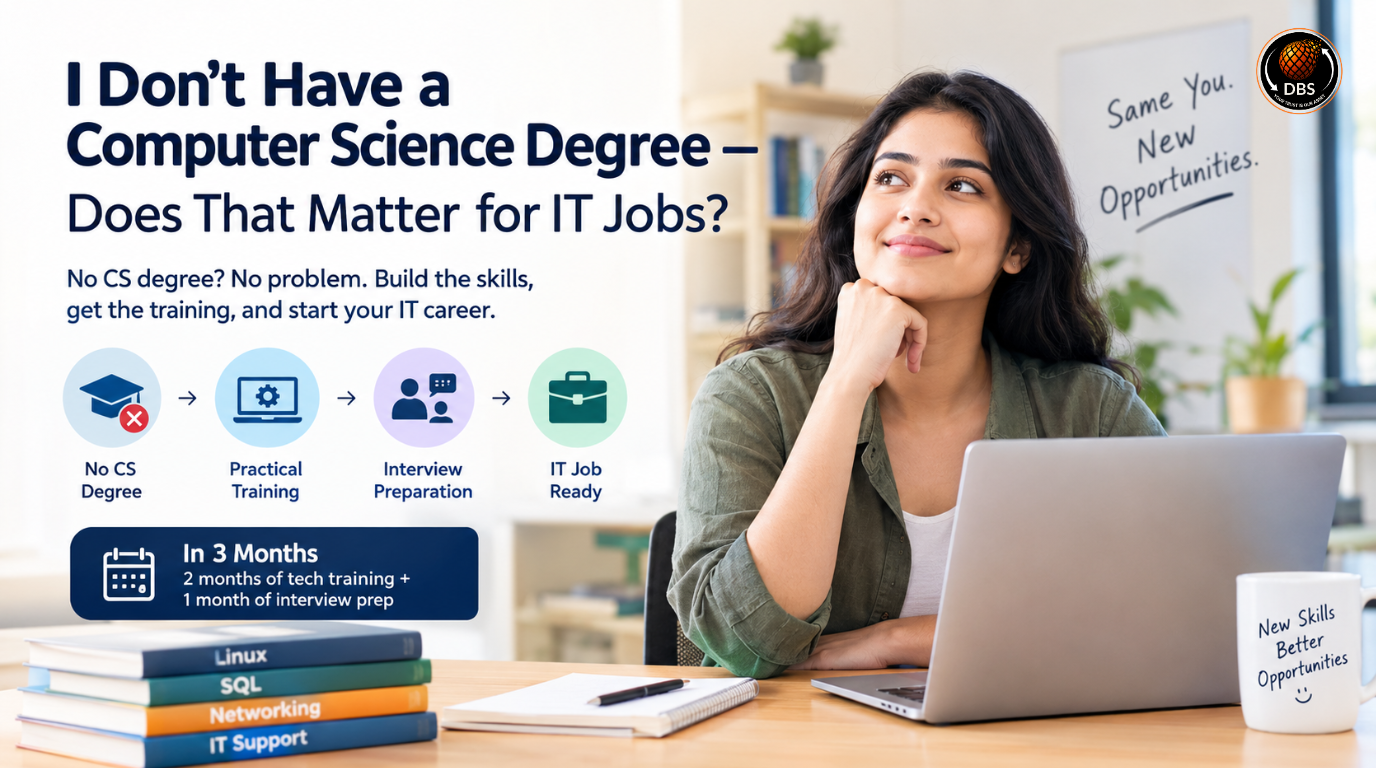
I Don’t Have a Computer Science Degree — Does That Matter for IT Jobs?
You see an IT job opening.
The role looks interesting.
The salary is better than your current job.
The growth looks promising.
Then you notice the qualification section:
“Computer Science or related degree preferred.”
That single line can make many non-IT professionals stop applying.
But does not having a Computer Science degree automatically eliminate you from an IT career?
No. But it also does not mean the degree never matters.
The reality is more specific.
Some IT roles have strict academic requirements, particularly highly specialized engineering, research and advanced technical positions.
Other roles place greater emphasis on practical skills, problem-solving, experience and the ability to demonstrate that you can perform the work.
The World Economic Forum’s Future of Jobs Report 2025 found that 48% of surveyed employers expect to use skills assessments between 2025 and 2030, while 43% expect university degrees to remain part of their assessment approach.
For India, the same report found that 30% of surveyed companies expect removing degree requirements and using skills-based hiring to help expand talent pools.
So the better question is not:
“Do I have a Computer Science degree?”
It is:
“Do I have the skills required for the IT role I want?”
Does a Computer Science Degree Matter for IT Jobs?
A Computer Science degree can be valuable.
It provides structured education in subjects such as programming, algorithms, databases, operating systems, computer networks and software development.
For certain roles, employers may explicitly require a relevant degree.
For example, current Microsoft job listings show that some advanced engineering and data positions specify Computer Science, engineering, mathematics or related degrees, while also allowing equivalent experience for certain positions.
That distinction matters.
Not every IT job has the same qualification requirements.
An entry-level IT support position is different from a machine learning research position.
A Business Analyst role is different from a software engineering role.
A QA position is different from a cloud architecture position.
Therefore, treating “IT” as one single career category can lead to poor career decisions.
Instead, identify the role first.
Then study its requirements.
Then build the skills that match those requirements.
For people without a Computer Science degree, the path may involve practical training, certifications, projects, transferable experience and targeted interview preparation.
Google’s IT Support Certificate, for example, states that no relevant experience is required and covers areas including networking, operating systems, system administration and security.
The lesson is simple:
A missing CS degree can close some doors, but it does not automatically close the entire IT industry.
What Employers Actually Look for in IT Candidates
Hiring requirements vary by company and role.
However, employers commonly evaluate whether a candidate can perform the responsibilities listed in the job description.
A degree may demonstrate formal education.
Skills and practical evidence can demonstrate what you can actually do.
The strongest approach is therefore to connect your learning directly to the job you want.
Practical Technical Skills
Technical skills give employers evidence that you understand the tools and processes used in the role.
For example, an entry-level candidate may need knowledge of:
- Operating systems
- Linux
- SQL
- Databases
- Networking fundamentals
- Business analysis
- Testing concepts
- Ticketing systems
- Documentation
- Data analysis
The exact combination depends on the position.
Google’s IT Support program specifically includes operating systems, networking, system administration and security as part of its curriculum.
The objective should not be to learn every technology.
Choose the technologies connected to your target role.
Problem-Solving Ability
IT work is rarely about memorizing commands.
A user reports a problem.
A system behaves unexpectedly.
A database query returns incorrect information.
A business requirement is unclear.
The candidate must understand the situation, identify the problem and work toward a solution.
This is why practical exercises matter.
Instead of only watching tutorials, work through scenarios.
Ask:
What is the problem?
What information do I need?
What tool should I use?
What result should I expect?
How would I explain the solution to someone else?
That process builds useful job skills.
Communication and Business Understanding
Technical knowledge alone does not guarantee success.
IT professionals often communicate with managers, customers, developers, testers, business teams and other departments.
A candidate who can explain a technical issue clearly can be more effective than someone who knows terminology but cannot communicate.
This is particularly important for roles such as Business Analyst, IT Support, QA, IT Operations and project-related positions.
Your previous non-IT experience can also become useful.
Someone from banking may understand financial processes.
Someone from healthcare may understand healthcare workflows.
Someone from BPO or KPO may understand customer communication and process management.
The goal is to connect that existing knowledge with technology.
Projects and Demonstrable Work
A resume saying “I know SQL” is weaker than evidence showing how you used SQL.
Build small practical projects.
For example:
- Create SQL queries for a business dataset.
- Analyze customer records.
- Document a Linux troubleshooting scenario.
- Create a sample Business Requirements Document.
- Prepare test cases for a simple application.
- Build an Excel-based business report.
Projects give you something concrete to discuss during interviews.
They also help you identify gaps before an employer does.
Which IT Jobs Can Non-IT Graduates Consider?
There is no universal list of “jobs anyone can get without a degree.”
Every company has its own requirements.
However, several technology-related career paths can be explored by people transitioning from non-IT backgrounds, depending on their existing education, skills and the specific employer.
Business Analyst
Business Analysts connect business requirements with technology teams.
They may gather requirements, document processes, communicate with stakeholders and help teams understand what a system should accomplish.
This can be a natural transition for professionals who already understand business processes.
Useful skills include:
- SQL fundamentals
- Requirement gathering
- Process mapping
- Documentation
- Excel
- Communication
- Jira
- Confluence
- Basic database concepts
A strong Business Analyst candidate should understand both the business problem and enough technology to communicate effectively with technical teams.
IT Support
IT Support is another possible entry point.
The work can involve troubleshooting operating systems, user issues, applications, networking problems and access-related concerns.
Google’s IT Support Certificate is designed for entry-level IT support preparation and states that no relevant experience is required.
Important skills include:
- Operating systems
- Networking basics
- Linux fundamentals
- Troubleshooting
- Security basics
- Customer communication
- Documentation
This path can suit people who enjoy solving problems and helping users.
QA and Software Testing
Quality Assurance involves checking whether software behaves as expected.
Entry-level testing work can include understanding requirements, creating test cases, executing tests, reporting defects and verifying fixes.
Useful skills include:
- Software testing fundamentals
- Test cases
- Bug reporting
- SDLC
- Agile concepts
- Jira
- Basic SQL
Automation testing requires additional programming knowledge, so candidates should understand the difference between manual testing and automation roles before choosing a learning path.
Data and Reporting Roles
Data-related roles range from reporting and business analysis to advanced data science.
The requirements vary significantly.
For entry-level reporting and analysis, useful skills can include:
- Excel
- SQL
- Data cleaning
- Data visualization
- Business communication
- Basic statistics
More advanced data roles may require programming, mathematics, machine learning or formal qualifications.
IT Project and Operations Roles
Technology projects require people who can organize requirements, track tasks, communicate with teams and maintain documentation.
Professionals with project coordination, operations or business experience may find transferable skills here.
Tools such as Jira and Confluence can be useful depending on the employer and role.
The important point is to select a role based on its actual requirements rather than choosing IT as a broad category.
Can You Enter IT Without Coding?
Yes, some IT career paths require little or no programming.
But “no coding” does not mean “no technical learning.”
You may still need to understand:
- Operating systems
- Databases
- SQL
- Networking
- Business processes
- Software development life cycles
- Testing
- IT tools
- Technical documentation
For example, a Business Analyst may not spend the day writing application code, but understanding databases, SQL and software development processes can make the professional more effective.
Similarly, an IT Support professional may not develop software but still needs to understand operating systems, networking and troubleshooting.
The right question is therefore:
“Which IT role matches my strengths and the technical skills I am willing to learn?”
That question produces a much more practical career plan than simply asking whether coding is required.
How to Move From Non-IT to IT
Moving into IT is easier when the transition is treated as a structured skills project.
Step 1 — Choose One IT Career Path
Do not start by learning ten technologies.
First choose a target.
Examples include:
- Business Analyst
- IT Support
- QA
- Data Analyst
- IT Operations
- Technical Support
Then study several current job descriptions for that role.
Create a list of recurring skills.
That list becomes your learning roadmap.
Step 2 — Learn the Required Technical Skills
Once the target role is clear, focus on the technologies that repeatedly appear in relevant job descriptions.
For example:
Business Analyst: SQL, requirements, documentation, process mapping and business communication.
IT Support: Linux, operating systems, networking, troubleshooting and security fundamentals.
QA: testing, test cases, defect management, SDLC and SQL fundamentals.
Focused learning is more efficient than collecting random certificates.
Step 3 — Build Practical Experience
Theory is useful.
Practical application is better.
Create realistic scenarios and projects.
Work with sample datasets.
Write SQL queries.
Document troubleshooting processes.
Create requirements documents.
Prepare test cases.
Practice explaining your work.
This creates evidence that can be discussed during interviews.
Step 4 — Prepare Your Resume
Your resume should connect your previous experience with your new IT direction.
Do not hide your non-IT background.
Use it strategically.
For example, a customer-service professional can highlight:
- Problem resolution
- Customer communication
- Process handling
- Escalation management
- Documentation
- Performance metrics
Then connect these transferable skills with newly developed IT skills.
Step 5 — Practice for Interviews
Many career switchers spend months learning and only a few days preparing for interviews.
Reverse that approach.
Start interview preparation while learning.
Practice:
- Technical questions
- Scenario questions
- HR questions
- Career-change questions
- Resume-based questions
- Communication
- Role-specific case studies
You should be able to explain not only what you learned but also how you used it.
How Digital Business Solutions Helps Non-IT Professionals Become IT-Ready
Digital Business Solutions is designed around a specific problem:
How can someone from a non-IT background build practical IT skills and prepare for the hiring process?
The DBS approach combines technical learning with interview preparation instead of treating them as completely separate activities.
The program is structured around a three-month learning and preparation journey.
The positioning should be understood correctly:
DBS does not award a Computer Science degree in three months.
Instead, the goal is to help eligible non-IT learners become IT-ready professionals through structured training and interview preparation.
This distinction is important.
A three-month training program cannot replace a formal university degree where an employer specifically requires one.
It can, however, help a learner build relevant skills for roles where practical knowledge and demonstrated ability are considered.
Month 1–2: Practical Technology Training
The first two months focus on practical technology learning.
The objective is to move beyond theoretical definitions.
Learners work with concepts and tools that can be relevant to entry-level IT roles.
Depending on the selected learning path, training can cover areas such as:
- Linux
- Unix
- SQL
- NoSQL
- Business Analysis
- Practical technical concepts
- Problem-solving scenarios
- Role-based exercises
The learning model can be particularly useful for professionals who feel that traditional technical education is too difficult to approach.
The goal is to explain concepts in a structured and understandable way.
Learners can also work through questions and practical scenarios rather than relying entirely on passive learning.
Month 3: Interview Preparation
Technical learning alone is not enough.
The third month focuses on turning that learning into interview readiness.
This can include:
- Mock tests
- Technical interview preparation
- Mock interviews
- Communication sessions
- Interview presentations
- Group interview practice
- Profile and resume preparation
- Live doubt sessions
- One-to-one guidance
This stage addresses a common career-switch problem.
A candidate may know the material but struggle to explain it.
Interview practice creates an opportunity to identify that gap before the actual interview.
The result is a more complete preparation process:
Non-IT Background → Technical Learning → Practical Preparation → Mock Interviews → IT Job Applications
What Can You Realistically Achieve in Three Months?
Three months can create meaningful progress.
It cannot guarantee a job.
It cannot replace every university qualification.
It cannot turn someone into a senior technology professional overnight.
What it can do is create a structured starting point.
A focused learner can use three months to:
- Understand a selected IT career path.
- Build foundational technical skills.
- Practice relevant tools.
- Complete practical exercises.
- Improve technical vocabulary.
- Create role-focused resume content.
- Practice common interview questions.
- Identify skill gaps.
- Develop better interview communication.
Google states that many learners complete its Career Certificates in three to six months, while its IT Support Certificate is designed for entry-level preparation and requires no relevant prior experience.
The important factor is not simply the number of months.
The quality, consistency and relevance of the learning matter.
A candidate who spends three months studying random technologies may remain unprepared.
A candidate who spends three months following a role-specific plan can build a much clearer foundation.
Common Mistakes Non-IT Candidates Make
Learning Everything at Once
Linux, Python, AWS, SQL, cybersecurity, AI, cloud computing and data science may all sound valuable.
Trying to learn everything simultaneously usually creates confusion.
Start with one target role.
Collecting Certificates Without Skills
Certificates can support a profile.
They should not become a substitute for practical ability.
If an interviewer asks you to solve a problem, you need to demonstrate what you know.
Hiding Previous Experience
Your previous career is not automatically irrelevant.
Customer handling, process knowledge, sales experience, banking operations, healthcare workflows and business communication can become transferable skills.
Show how those skills connect to your new role.
Ignoring Communication
IT professionals work with people.
Technical teams communicate with business teams.
Support teams communicate with customers.
Analysts communicate with stakeholders.
Good communication can make technical knowledge more useful.
Applying Without Reading the Job Description
Every IT role is different.
Read the job description.
Identify recurring requirements.
Compare them with your current skills.
Then close the most important gaps.
Frequently Asked Questions
Can I get an IT job without a Computer Science degree?
Yes, depending on the role and employer.
Some IT positions require a specific degree.
Others may place more emphasis on relevant skills, experience, certifications, projects or equivalent qualifications.
Always check the individual job description.
Can a non-IT graduate move into IT?
Yes.
A non-IT graduate can build technology skills and apply for suitable IT roles where the employer’s requirements allow it.
The transition should be based on a specific target role rather than trying to learn the entire IT industry.
Can a B.Com graduate get an IT job?
Potentially, yes.
A B.Com graduate can develop relevant technology skills for suitable roles such as Business Analysis, reporting, support or other technology-related positions, depending on employer requirements.
The degree does not automatically qualify someone for an IT role.
Relevant skills still need to be developed.
Can an MBA professional move into IT?
Yes.
An MBA background can provide useful business, process and communication knowledge.
Additional technical training may be required depending on the chosen role.
Business Analyst and technology project-related paths may be worth exploring when their requirements match the candidate’s background.
Can I start an IT career without coding?
Some IT roles require limited or no programming.
However, technical understanding is still important.
Roles such as Business Analysis, IT Support and manual QA can involve technology without requiring the same programming depth as software engineering.
Can three months of training guarantee an IT job?
No responsible training provider should present training duration as a job guarantee.
Three months can provide structured learning and interview preparation.
Hiring depends on multiple factors, including skills, role requirements, interview performance, experience, location, employer requirements and the candidate’s application strategy.
Does a Computer Science degree become useless?
No.
A Computer Science degree remains valuable and is required or preferred for many technical positions.
The important point is that the IT industry contains many different roles with different qualification requirements.
A CS degree is one route into IT.
It is not the only route for every position.
Final Takeaway
Not having a Computer Science degree does not automatically mean you cannot build an IT career.
But you should also avoid the opposite assumption that a degree never matters.
The reality depends on the role, employer and qualification requirements.
Some positions require formal academic qualifications.
Others may consider practical skills, experience, certifications, projects and demonstrated ability.
For non-IT professionals, the most practical strategy is to:
- Choose a specific IT career path.
- Study the skills employers request.
- Build practical knowledge.
- Create evidence of your abilities.
- Prepare a role-focused resume.
- Practice technical and HR interviews.
- Apply to positions that match your qualifications.
Digital Business Solutions follows this type of structured approach through a three-month program:
2 months of practical technology training + 1 month of interview preparation.
The objective is not to manufacture a university degree in three months.
The objective is to help non-IT professionals become IT-ready, develop relevant technical skills and prepare for the hiring process.
If your current qualification is not in Computer Science, that does not have to be the end of the conversation.
It may simply mean your next step is to build the skills that your target IT role requires.
Your degree is part of your profile.
Your skills are another part.
Your ability to demonstrate those skills is what you need to work on next.
Take the first step toward your IT career today.
Digital Business Solutions IT — Helping Non-IT Professionals Build Their Future in IT.
Book your free career consultation: https://forms.gle/spZqzEs2WGxepktg6
Watch real stories and career tips on our podcast: https://youtu.be/xlrOIaZTwWI
Follow Digital Business Solutions IT for weekly career tips:
- Instagram: @official_biplob_mandal
- LinkedIn: Biplob Mandal
Call us: +91 9307867881 / +91 7558759407
Email: contactus@digitalbusinesssolutionsforyou.com
Visit us: Office No. 412, 4th Floor, City Space, Digital Business Solutions IT, Pune Nagar Rd, above Aakash Eye Clinic, Viman Nagar, Pune, Maharashtra 411014
Tag:3 month IT course, Business Analyst Career, can I get an IT job without a Computer Science degree, Career Change to IT, career transformation, computer science degree for IT jobs, DBS IT, Digital Business Solutions, entry-level IT jobs, how to get an IT job without a CS degree, how to move from non-IT to IT, interview preparation for IT jobs, IT career change, IT career for non-IT graduates, IT career without a technical degree, IT courses for non-technical graduates, IT Interview Preparation, IT jobs for non-technical graduates, IT jobs without a Computer Science degree, IT jobs without a degree, IT Jobs Without Coding, IT skills, IT Support jobs, IT training for non-IT professionals, IT-ready professionals, Linux training, non-IT to IT career, non-IT to IT transition, non-technical background to IT, practical IT training, QA testing jobs, skills for IT jobs, SQL training, tech career without coding, technology careers, technology skills, three month IT training