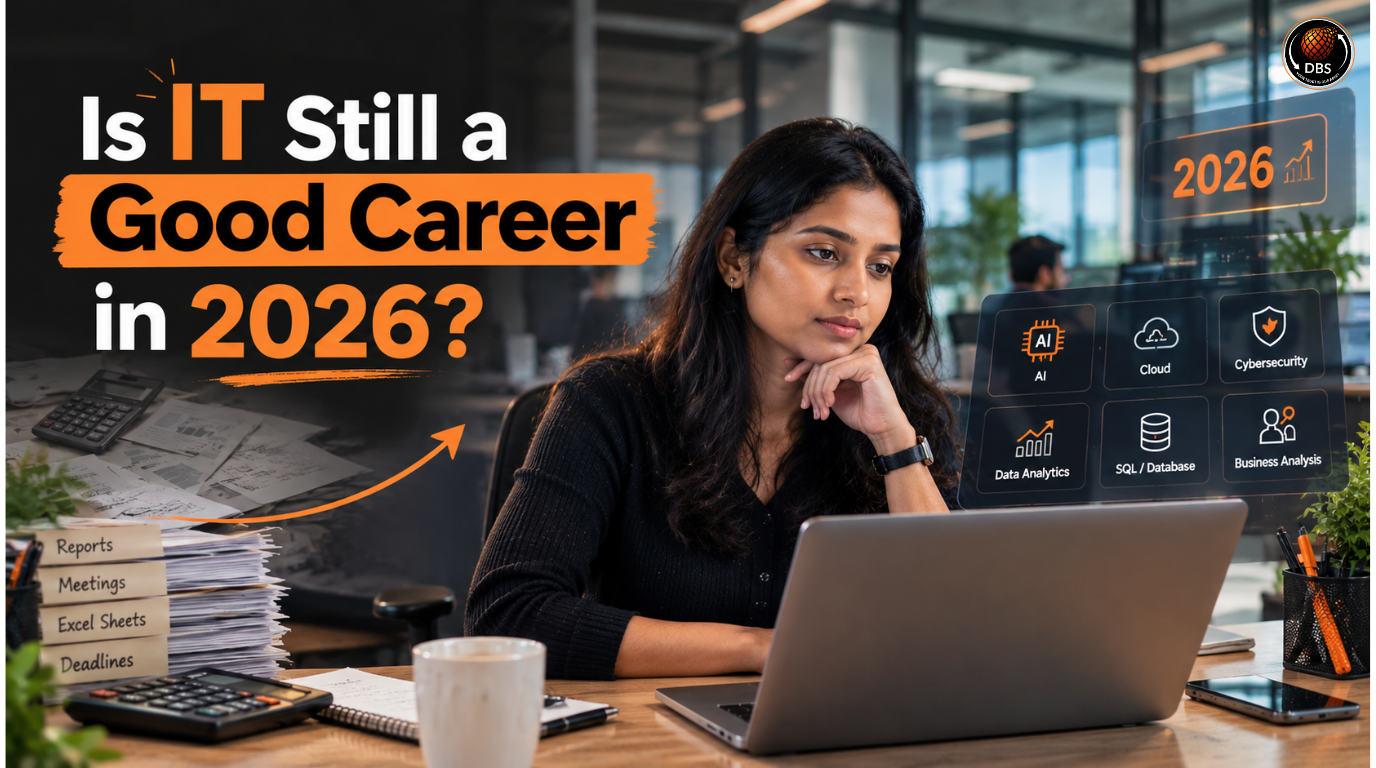
Is IT Still a Good Career in 2026? Answering the Question Everyone’s Afraid to Ask
For years, IT has been presented as one of the safest career choices.
Then AI changed the conversation.
Generative AI can write code, analyse data, create reports, automate repetitive tasks and support customer service. At the same time, layoffs across parts of the technology industry have made many professionals question whether entering IT in 2026 is still a smart move.
So, is IT still a good career in 2026?
The honest answer is more useful than a simple yes or no.
IT is still a major source of career opportunities, but the type of work companies need is changing.
The World Economic Forum’s Future of Jobs Report 2025 identified technology-related roles such as big data specialists, AI and machine learning specialists and software developers among the fastest-growing roles through 2030. It also identified AI and big data, networks and cybersecurity, and technological literacy among the fastest-growing skill areas.
India’s technology market also remains significant.
IBEF, citing NASSCOM data, reports that India’s IT and BPM industry generated an estimated US$315.4 billion in FY26, with IT exports estimated at US$246.4 billion through February 2026.
That does not mean every IT job is safe.
It means the question has changed.
Instead of asking:
“Is IT safe?”
A better question is:
“Which IT skills and roles are becoming more valuable, and how can I build them?”
Is IT Still a Good Career in 2026?
Yes, IT remains a significant career field in 2026, but it is no longer enough to simply enter the industry and expect long-term growth.
The technology industry is changing because businesses are changing.
Companies are investing in cloud infrastructure, cybersecurity, artificial intelligence, data, automation, software and digital systems.
Those investments create demand for people who can build, manage, analyse, secure and improve technology.
The World Economic Forum expects technology skills to increase in importance faster than other skill categories over the next five years. AI and big data rank at the top, followed by networks and cybersecurity and technological literacy.
The U.S. Bureau of Labor Statistics also projects strong growth across several technology-related occupations.
For example, its 2024–2034 projections show:
- Data scientists: +33.5%
- Information security analysts: +28.5%
- Software developers: +15.8%
- Computer systems analysts: +9%
These are U.S. occupational projections, so they should not be treated as direct forecasts for India’s job market. They are useful as an indication of broader technology demand.
India has its own strong technology ecosystem.
IT spending in India is expected to reach approximately US$176.3 billion in 2026, according to Gartner data reported by IBEF.
So the opportunity has not disappeared.
But the entry requirements are changing.
Companies increasingly need people who can use technology to solve business problems.
That means learning one tool is not enough.
A stronger career profile combines:
- Technical skills
- Business understanding
- Analytical thinking
- Communication
- Problem-solving
- AI awareness
- Practical project experience
The real advantage in 2026 is not simply knowing technology.
It is knowing how to use technology to produce useful business outcomes.
Why Are People Asking If IT Is Still Worth It?
The question is understandable.
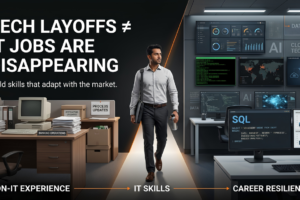
Technology layoffs, automation and AI have created uncertainty.
Someone considering an IT career may see headlines about companies reducing headcount and wonder:
“Why should I enter an industry that is replacing people with AI?”
The important distinction is between job displacement and job transformation.
AI can automate certain tasks without eliminating the entire occupation.
For example, an analyst may use AI to generate a first version of a report.
A developer may use AI to produce code.
A support professional may use AI to classify common issues.
A cybersecurity professional may use AI to identify suspicious activity.
The person’s role can change without disappearing.
The World Economic Forum expects significant labour-market disruption through 2030, with 170 million jobs created and 92 million displaced globally across all sectors. Its research also shows that technological skills and human skills will both become increasingly important.
This is why “AI versus humans” is an incomplete way to look at the employment market.
A more realistic question is:
“What tasks will AI handle, and what will professionals still need to understand, verify and manage?”
That distinction matters for anyone planning an IT career.
Will AI Replace IT Jobs?
AI will replace or reduce some tasks.
It will also create new tasks and increase demand for certain technology skills.
The effect will not be identical across every IT role.
Highly repetitive work is generally more exposed to automation.
Work involving problem-solving, system design, security, business decisions, stakeholder communication and accountability requires broader human involvement.
The U.S. Bureau of Labor Statistics’ 2026 analysis similarly projects growth in several AI-related and technology occupations while projecting declines in some administrative and routine roles.
For a career starter, the lesson is simple:
Do not build your career around tasks that can easily be automated.
Build skills around understanding systems, solving problems and using technology effectively.
AI should become part of your toolkit rather than something you completely ignore.
Which IT Careers Have Demand in 2026?
IT is not one single career.
It includes many different paths, and they require different combinations of skills.
Some roles require advanced programming.
Others focus more on analysis, systems, operations, security, testing or business processes.
For someone entering IT, this distinction is important because not every technology career requires the same level of coding.
Potential career paths include:
- Business Analyst
- Data Analyst
- Cybersecurity
- Cloud Support
- Technical Support
- Quality Assurance
- IT Project Management
- Systems Analyst
- Software Development
- Data Science
- AI and Machine Learning
The World Economic Forum identifies big data specialists, fintech engineers, AI and machine learning specialists and software and applications developers among the fastest-growing roles through 2030. Security-related roles also feature prominently.
In India, the growth of cloud, AI, cybersecurity, data centres and Global Capability Centres is also creating new technology-related requirements. IBEF reports that India’s GCC workforce is projected to reach 3.46 million by 2030, with AI-related roles becoming increasingly important.
The important point is not to chase every new job title.
Choose a path based on:
- Your existing experience
- Your interests
- Your learning capacity
- The skills required for the role
- The type of work you want to do
A person from banking may have useful business and process knowledge for a Business Analyst role.
Someone from customer support may already have communication and problem-solving experience relevant to IT support.
Someone from finance may have analytical experience that can support a move toward data-related work.
Your previous career is not necessarily something you need to erase.
It can become part of your IT profile.
Is Coding Required for Every IT Career?
No.
Coding is essential for some technology roles, but it is not the primary skill for every IT career.
Business analysts, project managers, some IT support professionals, systems analysts and other roles can involve more focus on processes, systems, documentation, analysis, communication and problem-solving.
That does not mean these roles require no technical knowledge.
You still need to understand the technology you work with.
For example, a Business Analyst may need to understand databases, SQL, APIs, software development processes and business requirements.
An IT support professional may need knowledge of operating systems, networks, troubleshooting and basic commands.
The better question is not:
“Can I avoid technology?”
It is:
“Which technology skills does my target role actually require?”
What Skills Should You Learn for an IT Career in 2026?
The skills you need depend on your target role.
However, several skill categories are becoming increasingly useful across technology careers.
1. SQL and Data Basics
Data is used across almost every modern business.
SQL helps professionals retrieve and work with information stored in relational databases.
Even professionals who are not aiming to become database engineers can benefit from understanding:
- SELECT
- FROM
- WHERE
- JOIN
- GROUP BY
- Basic filtering
- Data relationships
2. Linux and Operating Systems
Linux is widely used across servers, cloud infrastructure, cybersecurity and development environments.
Learning basic commands can help beginners understand how technology systems work.
3. Cloud Fundamentals
Cloud computing is now a major part of modern IT infrastructure.
Beginners should understand concepts such as:
- Servers
- Storage
- Virtual machines
- Networking
- Databases
- Cloud services
- Security basics
4. Cybersecurity Awareness
Security is not only the responsibility of cybersecurity teams.
Modern technology professionals need to understand basic security concepts, access control, authentication, vulnerabilities and safe data handling.
5. AI Literacy
AI literacy does not necessarily mean becoming an AI engineer.
It means understanding:
- What AI can do
- Where AI can fail
- How to verify AI-generated output
- How to use AI tools effectively
- How AI affects your role
The World Economic Forum ranks AI and big data, networks and cybersecurity and technological literacy among the fastest-growing skill areas.
Are Soft Skills Still Important in IT?
Yes.
Technical ability alone does not cover every requirement of a modern IT role.
Professionals often need to explain problems, communicate with stakeholders, document work, ask useful questions and collaborate with different teams.
The World Economic Forum expects creative thinking, resilience, flexibility, curiosity, analytical thinking and leadership-related skills to remain important alongside technology skills.
This creates an important opportunity for people switching careers.
Your previous experience may already include transferable skills.
For example:
A customer service professional may have communication and problem-solving experience.
A banking professional may understand financial processes and customer requirements.
A sales professional may understand clients, targets and business communication.
The goal is to combine those existing strengths with relevant technology skills.
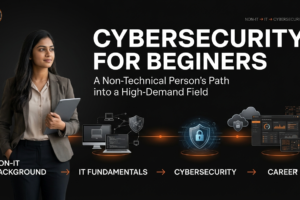
Can You Switch From Non-IT to IT in 2026?
Yes, but a career switch should be treated as a structured learning and job-preparation process rather than simply collecting certificates.
A non-IT background does not automatically prevent someone from entering technology.
But companies still need evidence that you can perform the work.
That evidence can come from:
- Practical projects
- Relevant skills
- Interview preparation
- Role-specific knowledge
- A clear resume
- Strong communication
- Demonstrable problem-solving ability
A career switch becomes easier to explain when your story connects your previous experience to your target IT role.
For example:
A banking professional moving toward Business Analysis can connect banking processes with requirements gathering, documentation and data analysis.
A BPO professional moving toward IT support can connect customer handling with troubleshooting, ticket management and technical support.
A finance professional moving toward data analysis can connect financial reporting with SQL, Excel, dashboards and data interpretation.
The strongest transition is not:
“I want to leave my old career.”
It is:
“I have existing business experience, and I am adding technology skills to move into a new role.”
That difference can make your profile easier to understand.
Can You Enter IT Without a Computer Science Degree?
It depends on the role and employer.
Some technology positions list a computer science or related bachelor’s degree as a typical requirement.
Other roles may have different education requirements or place more emphasis on relevant skills and experience.
For example, the U.S. Bureau of Labor Statistics lists a bachelor’s degree as the typical entry-level education for several technology occupations, including software development, systems analysis and information security analysis.
Therefore, “no degree required for IT” is too broad a claim.
A better approach is to research the specific job role.
Look at 20–30 current job descriptions for your target position.
Identify repeated requirements.
Then build your learning plan around those requirements.
What Has Changed About IT Careers in 2026?
The biggest change is that companies are increasingly looking for people who can work effectively with technology rather than simply people who have technology-related job titles.
Several shifts stand out.
AI is becoming part of everyday work
AI tools are being integrated into development, analytics, support, documentation and business processes.
Knowing how to use them responsibly is becoming useful across many roles.
Routine work is more exposed to automation
Repetitive tasks can increasingly be automated.
This increases the value of problem-solving, decision-making and system understanding.
Employers need broader skill sets
The World Economic Forum reports that 59 out of every 100 workers could require reskilling or upskilling by 2030 under its employer-survey scenario.
Practical ability matters
Knowing a definition is different from performing the task.
Someone who understands SQL theoretically but cannot write a basic query may struggle in an interview.
The same applies to Linux, cloud, testing, data analysis and business analysis.
The career lesson is straightforward:
Learn less randomly.
Learn more intentionally.
Is the IT Job Market Too Competitive in 2026?
Competition exists.
That does not mean there are no opportunities.
The more important issue is whether your skills match the roles you are applying for.
A generic resume saying:
“Hardworking professional seeking an IT opportunity”
does not tell an employer what you can do.
A stronger profile might communicate:
“Business professional with SQL, requirements analysis, documentation and dashboard experience, seeking Business Analyst roles.”
Specificity helps employers understand your value.
Competition also means beginners should not depend only on certificates.
Build practical examples.
Create projects.
Practice interviews.
Understand your target job description.
Learn the terminology used in your chosen role.
Be able to explain what you built and why it matters.
Is IT Still Worth It for Freshers and Career Changers?
The answer depends on what you expect from the career.
If you expect a short course to guarantee a job immediately, the IT market may feel difficult.
If you are prepared to learn continuously, build practical skills and apply strategically, IT remains a significant career field.
India’s IT ecosystem continues to operate at substantial scale.
IBEF reports estimated FY26 IT and BPM industry revenue of US$315.4 billion and says India’s IT spending is expected to reach US$176.3 billion in 2026.
Hiring is also not limited to traditional software companies.
Technology roles increasingly exist inside:
- Banks
- Healthcare companies
- Insurance companies
- Retail businesses
- Manufacturing companies
- Consulting firms
- Startups
- Global Capability Centres
- E-commerce companies
This matters for career changers because you do not necessarily have to abandon your previous industry knowledge.
You can combine domain knowledge with technology skills.
That combination can create a different route into IT.
How to Start an IT Career in 2026
Starting does not require learning everything.
It requires choosing a direction.
Step 1: Choose one target role
Do not begin with:
“I want to learn IT.”
Begin with:
“I want to become a Business Analyst.”
Or:
“I want to move into IT support.”
Or:
“I want to become a Data Analyst.”
A specific target gives your learning plan a purpose.
Step 2: Study the required skills
Read current job descriptions.
Create a list of repeated requirements.
Separate them into:
- Must-have
- Useful
- Advanced
Start with the must-have skills.
Step 3: Build practical projects
Do not only watch lessons.
Create something.
For example:
- SQL data analysis project
- Business requirements document
- Dashboard
- IT support troubleshooting scenario
- Linux practice environment
- QA test cases
- Cloud fundamentals project
Step 4: Prepare your resume
Your resume should show relevant skills rather than simply listing every course you have completed.
Step 5: Practice interviews
Prepare for:
- Technical questions
- Role-specific questions
- Scenario questions
- HR questions
- Questions about your career transition
Step 6: Apply consistently
Do not judge your career based on five applications.
Track your applications and improve your resume and interview performance based on patterns you observe.
How Long Does It Take to Become IT-Ready?
There is no universal timeline.
It depends on your starting point, target role, previous experience, available study time and the level of skill required.
Someone with strong analytical experience may progress faster in a data-related role.
Someone with customer-service experience may have a smoother starting point for certain support roles.
The goal should not be:
“Finish IT in 30 days.”
The goal should be:
“Become capable of performing the basic work expected in my target role.”
A practical learning plan can include:
- Core concepts
- Tools
- Practical exercises
- Projects
- Resume preparation
- Mock interviews
- Job applications
The timeline should be based on skill readiness rather than an arbitrary number of days.
What Should You Avoid When Starting an IT Career in 2026?
Avoid Learning Everything
IT is too broad.
Trying to learn Python, Java, cloud, cybersecurity, data science, testing, SQL and AI simultaneously can create shallow knowledge.
Choose one direction first.
Avoid Certificate Collection
Certificates can support a profile, but they do not replace practical ability.
Avoid Ignoring AI
You do not need to become an AI engineer.
But understanding how AI affects your target role is increasingly important.
Avoid Copying Someone Else’s Career Path
A software developer’s roadmap will not necessarily work for a Business Analyst.
A cybersecurity roadmap will not necessarily work for an IT support professional.
Avoid Hiding Your Previous Experience
Your previous career can provide useful domain knowledge.
Use it.
H2: The Real Answer: Is IT Still a Good Career in 2026?
The IT industry in 2026 is neither the guaranteed career path it was sometimes presented as nor a dying industry.
It is changing.
AI is automating some tasks.
Cloud and digital infrastructure are expanding.
Cybersecurity needs are increasing.
Data continues to influence business decisions.
Software remains central to modern organisations.
At the same time, employers are becoming more selective about skills.
The evidence points to continued technology-related demand, but also to significant workforce disruption and changing skill requirements. The World Economic Forum expects technology skills to rise rapidly in importance, while U.S. labour projections show strong growth in several technology occupations. India’s technology industry remains a major economic sector, with substantial IT spending and industry revenue.
So the useful conclusion is not:
“IT is completely safe.”
Nor is it:
“AI has killed IT careers.”
The better conclusion is:
IT remains a major career field, but the professionals who adapt their skills to changing technology and business needs will have to keep learning.
For someone considering a move from non-IT to IT, that means the opportunity is still there.
But the path should be skill-driven.
Choose a role.
Learn the relevant tools.
Build practical experience.
Understand AI.
Improve communication.
Prepare for interviews.
Then apply.
The IT career of 2026 is not about knowing every technology.
It is about being able to use the right technology to solve real problems.
Quick Checklist: Should You Consider an IT Career in 2026?
Ask yourself:
- Am I willing to learn continuously?
- Have I selected a specific IT role?
- Do I understand the skills required for that role?
- Can I build practical projects?
- Am I comfortable learning basic technical concepts?
- Can I communicate my career transition clearly?
- Am I prepared for interviews?
- Can I use AI tools responsibly?
- Am I willing to improve after feedback?
If several answers are “no,” that does not mean you cannot enter IT.
It means you have a clearer list of what to work on.
Final Takeaway
IT is still a major career field in 2026.
But the old formula of “learn technology → get an IT job → stay secure” is no longer enough.
The modern approach is:
Skill + Practical Experience + Business Understanding + AI Awareness + Continuous Learning.
For non-IT professionals, the opportunity is not necessarily about starting from zero.
Your existing industry knowledge, communication skills and work experience can become part of your transition.
Add the right IT skills to that foundation.
Then build a profile that shows employers what you can actually do.
That is a much more useful way to think about an IT career in 2026.
FAQ Section
Is IT still a good career in 2026?
Yes, IT remains a major career field, but the skills companies need are changing. AI, data, cybersecurity, cloud and technological literacy are increasingly important areas.
Will AI replace IT jobs?
AI is expected to automate some tasks and change many technology roles. At the same time, technology adoption is creating demand for new skills and occupations. The impact differs by role.
Can I switch from non-IT to IT in 2026?
Yes. The transition depends on the target role, relevant skills, practical experience and interview readiness. Your previous industry experience can also provide useful domain knowledge.
Can I get an IT job without coding?
Some IT roles require little or no programming as a primary responsibility. Business analysis, project management and certain support roles can focus more on systems, processes, analysis and communication, although technical knowledge is still useful.
Which IT skills should I learn in 2026?
The right skills depend on your target role. Commonly useful areas include SQL, data fundamentals, cloud concepts, Linux, cybersecurity awareness, AI literacy, analytical thinking and communication.
Is a computer science degree required for IT?
Requirements vary by role and employer. Some technology occupations commonly require a relevant bachelor’s degree, while other positions may use different education and experience requirements. Always check current job descriptions for your target role.
Is IT too competitive in 2026?
Competition exists, particularly for entry-level roles. Candidates can improve their position by developing role-specific skills, building practical projects, preparing for interviews and clearly demonstrating what they can do.
What is the future of IT jobs?
The IT job market is expected to continue changing as AI, cloud computing, cybersecurity, data and automation expand. Some tasks and roles may decline while new roles and skill requirements emerge.
Digital Business Solutions IT — Empowering Non-IT Professionals to Build Their Future in IT.
Take the first step toward your IT career today.
Digital Business Solutions IT — Helping Non-IT Professionals Build Their Future in IT.
Book your free career consultation: https://forms.gle/spZqzEs2WGxepktg6
Watch real stories and career tips on our podcast: https://youtu.be/xlrOIaZTwWI
Follow Digital Business Solutions IT for weekly career tips:
- Instagram: @official_biplob_mandal
- LinkedIn: Biplob Mandal
Call us: +91 9307867881 / +91 7558759407
Email: contactus@digitalbusinesssolutionsforyou.com
Visit us: Office No. 412, 4th Floor, City Space, Digital Business Solutions IT, Pune Nagar Rd, above Aakash Eye Clinic, Viman Nagar, Pune, Maharashtra 411014