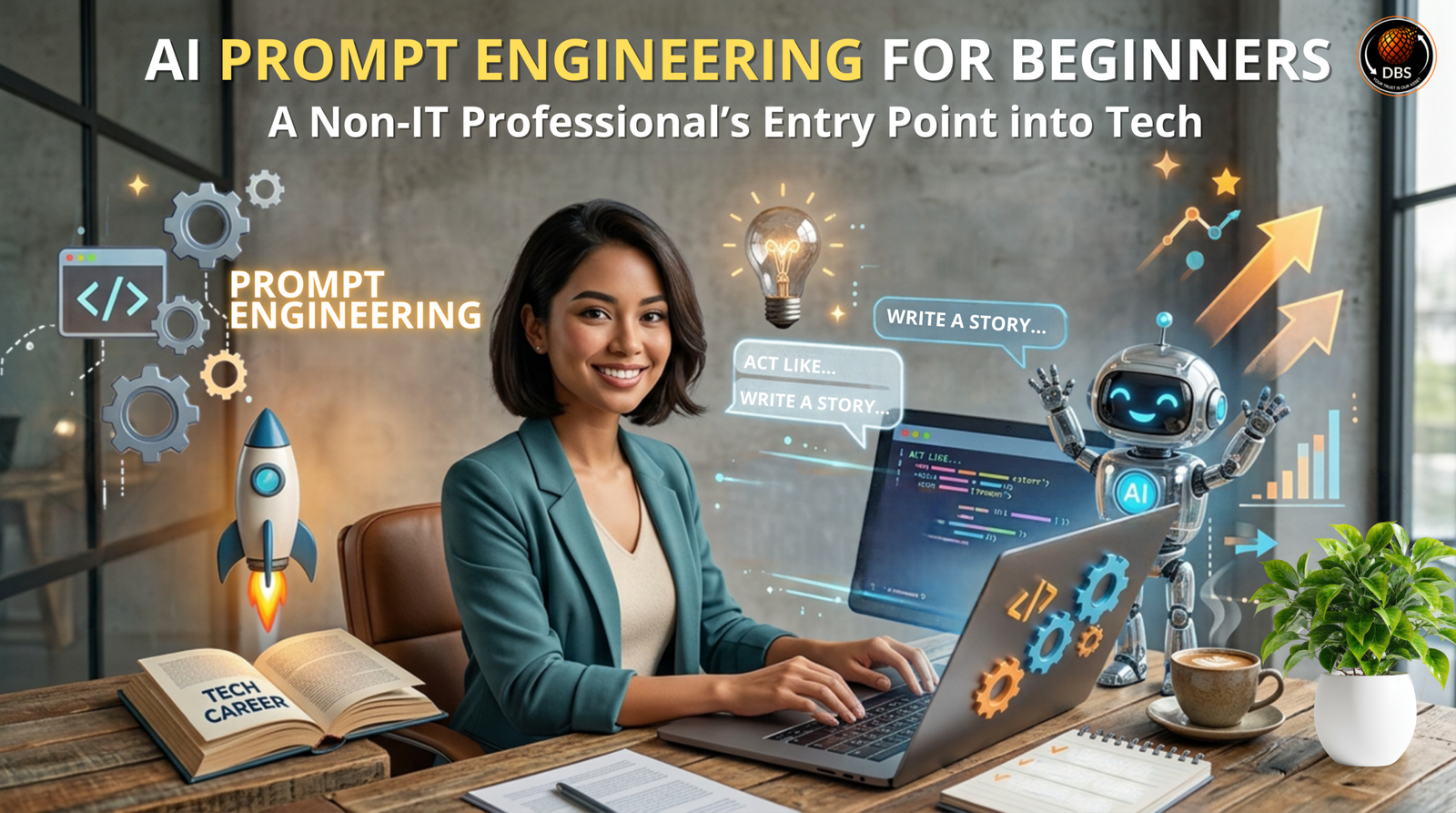
AI Prompt Engineering for Beginners: A Non-IT Professional’s Entry Point into Tech
Artificial intelligence is changing how people work, communicate, analyze information, and solve business problems.
But learning AI does not always mean becoming a software developer.
One practical starting point is prompt engineering — the process of creating clear instructions that help AI systems produce useful and relevant results.
For non-IT professionals, prompt engineering can be a practical way to develop AI literacy, improve workplace productivity, and understand how modern technology is used in business.
It can also become one part of a broader transition from a non-IT career into IT.
What Is AI Prompt Engineering?
Prompt engineering is the practice of writing, refining, and organizing instructions for an AI system to generate a desired result.
A prompt can be as simple as:
“Write a professional email requesting a meeting.”
But a stronger prompt gives the AI additional context, requirements, format, and audience.
For example:
“Write a professional 100-word email to a corporate client requesting a meeting next week. Keep the tone polite and concise.”
The second instruction gives the AI more information about the expected output.
Why Do Prompts Matter?
AI systems respond to the information and instructions provided by the user.
A vague prompt can produce a generic answer.
A structured prompt can produce a more useful response.
A practical prompt often contains:
- Role: Tell the AI what perspective to use.
- Task: Clearly explain what needs to be done.
- Context: Provide relevant background information.
- Constraints: Specify length, tone, format, or limitations.
- Output: Explain how the final response should look.
For beginners, this makes prompt engineering less about technical programming and more about clear communication, logical thinking, problem definition, and testing.
These are skills that many professionals already use in their existing jobs.
Does Prompt Engineering Require Coding?
One of the biggest misconceptions about AI is that every AI-related career requires advanced programming.
Prompt engineering itself can often be practiced without writing traditional code.
A beginner can start by learning how to:
- Give precise instructions.
- Provide useful context.
- Break complicated tasks into smaller steps.
- Ask AI to produce specific formats.
- Review AI-generated responses.
- Identify errors and improve prompts.
- Compare different outputs.
- Build repeatable prompt workflows.
Coding vs. Prompt Engineering
Coding involves creating instructions that computers execute through programming languages.
Prompt engineering involves communicating instructions to an AI model using natural language and, in some cases, structured inputs.
The two areas can overlap.
For example, an AI professional working with APIs or automation may eventually benefit from Python, JavaScript, SQL, or other technical skills.
However, someone starting with prompt engineering does not necessarily need to begin with advanced programming.
That makes AI prompt engineering an accessible skill area for professionals from business, commerce, operations, sales, customer service, finance, healthcare, and other backgrounds.
Why Prompt Engineering Can Be Useful for Non-IT Professionals
A career change does not always have to begin with learning an entire technology stack.
It can begin with understanding one practical technology and learning how it applies to real business work.
Prompt engineering provides that opportunity.
A banking professional could use AI to organize customer-service information.
A sales professional could use AI to structure prospect research.
An HR professional could use AI to create interview question frameworks.
A business professional could use AI to summarize documents or organize requirements.
The key is not simply knowing how to ask an AI tool a question.
The valuable skill is understanding what problem needs to be solved, what information the AI needs, and how to evaluate its output.
Transferable Skills From Non-IT Careers
Non-IT professionals often already have skills that can support AI-related work.
Examples include:
- Communication
- Business understanding
- Customer interaction
- Documentation
- Research
- Problem-solving
- Process management
- Data interpretation
- Presentation
- Domain knowledge
These skills can become useful when combined with AI and technology knowledge.
This is why a career switch should not be viewed as throwing away previous experience.
Instead, professionals can build new technology skills around the experience they already have.
How to Start Learning Prompt Engineering
A beginner does not need to learn everything about artificial intelligence at once.
A simple learning sequence can make the process easier.
Step 1: Understand How AI Tools Work
Start with basic concepts.
Learn what generative AI is, what large language models do, and why AI responses can sometimes contain incorrect information.
You do not need advanced mathematics to understand these fundamentals.
The goal is to know what AI can do, where it performs well, and where human review remains necessary.
Step 2: Learn Prompt Structure
Practice prompts using a consistent framework.
A useful beginner formula is:
Role + Context + Task + Requirements + Output Format
For example:
“Act as a customer-support manager. Review the following complaint. Identify the customer’s main concern and create a professional response in 100 words.”
This is more specific than simply asking:
“Reply to this customer.”
Step 3: Practice With Real Tasks
Use realistic workplace scenarios.
Try prompts for:
- Email writing
- Data summarization
- Meeting notes
- Research
- Customer communication
- Job descriptions
- Interview preparation
- Business reports
- Content planning
Practical repetition helps you understand how small changes in instructions affect results.
Step 4: Verify the Output
Never treat AI output as automatically correct.
Check:
- Facts
- Numbers
- Names
- Sources
- Assumptions
- Missing information
- Business context
Good AI use includes human judgment.
What Skills Should a Beginner Build?
Prompt engineering is more useful when combined with broader workplace and technology skills.
AI Literacy
Understand basic AI concepts, common AI tools, limitations, and responsible use.
Communication
Clear writing helps you create better instructions.
You need to explain what you want without unnecessary ambiguity.
Analytical Thinking
AI may generate several possible answers.
You need to determine which output is useful and what needs improvement.
Problem-Solving
Instead of asking AI random questions, identify the business problem first.
Then determine how AI can assist with it.
Basic Data Skills
Learning spreadsheets, SQL, data concepts, or basic analytics can expand your technology options.
Business Understanding
AI is valuable when it solves a real problem.
Understanding business processes can therefore be just as important as understanding the AI tool itself.
Can Prompt Engineering Help You Move From Non-IT to IT?
Prompt engineering can be a starting skill, but it should not be treated as a guaranteed job pathway.
The IT industry contains many different roles.
Some involve software development.
Others focus on business analysis, data, quality assurance, technical support, cloud operations, project management, cybersecurity, and other areas.
For a non-IT professional, the better approach is to identify a suitable technology career path and then build the skills required for that role.
Combining Existing Experience With Technology
Suppose someone has five years of experience in banking.
Starting again as a complete beginner may not be the only option.
They could explore technology roles where their banking knowledge remains useful.
Similarly, a BPO professional may already understand customer processes, communication, escalation management, and service operations.
Adding technology skills can create a different professional profile.
This approach is often called a career transition rather than simply starting a new career from zero.
How Digital Business Solutions IT Helps Non-IT Professionals
Digital Business Solutions IT (DBS IT) focuses on helping non-IT professionals understand technology and prepare for a move into IT.
The approach is designed for people who may come from backgrounds such as:
- BPO
- KPO
- Banking
- Finance
- Healthcare
- Insurance
- Sales
- Commerce
- Arts
- Business administration
DBS IT’s training approach focuses on making technology concepts easier to understand for learners who may not have a traditional technical background.
Practical Technology Learning
Rather than focusing only on theoretical concepts, learners can work with practical topics such as:
- Linux
- Unix
- SQL
- NoSQL
- Business Analysis
- AI concepts
- Interview preparation
- Workplace communication
The objective is to help learners understand how technology is used in professional environments.
Career Preparation
Learning technology is only one part of changing careers.
A non-IT professional also needs to understand how to present their existing experience, build a suitable profile, communicate their skills, and prepare for interviews.
DBS IT combines technical learning with career preparation, including practical sessions, mock tests, communication sessions, mock interviews, and interview practice.
The training model includes two months of practical training followed by one month focused on end-to-end interview preparation.
This gives learners a structured route from learning concepts to preparing for job opportunities.
AI Prompt Engineering vs. Traditional IT Skills
Prompt engineering can be useful, but it should not replace foundational technology skills when a specific IT role requires them.
Consider the difference:
| Skill Area | What It Helps With |
| Prompt Engineering | Working effectively with AI tools |
| SQL | Working with structured data |
| Linux | Understanding operating environments |
| Business Analysis | Understanding business requirements |
| Data Analytics | Finding patterns in data |
| Cloud | Working with cloud-based infrastructure |
| QA | Testing software and processes |
| Technical Support | Resolving technology-related issues |
For many career changers, the strongest approach may be to combine AI literacy + a defined IT skill + existing professional experience.
Common Mistakes Beginners Make With Prompt Engineering
Writing Extremely Vague Prompts
“Tell me about marketing” gives little direction.
Instead, specify the audience, objective, format, and context.
Assuming AI Is Always Correct
AI can produce inaccurate or outdated information.
Always verify important claims.
Focusing Only on Prompt Templates
Templates can help beginners.
But understanding the underlying task is more important than memorizing hundreds of prompts.
Ignoring Privacy
Do not paste confidential company information, customer data, passwords, financial records, or other sensitive information into AI tools without appropriate authorization and safeguards.
Expecting One Skill to Guarantee a Job
Prompt engineering is one skill.
Career opportunities depend on the role, employer requirements, experience, portfolio, communication, and other qualifications.
A Simple 90-Day Learning Roadmap
Days 1–30: Build AI Fundamentals
Learn:
- Generative AI basics
- Large language model fundamentals
- Prompt structure
- AI limitations
- Responsible AI use
- Basic prompt testing
Practice with everyday professional tasks.
Days 31–60: Add Technology Skills
Choose a direction based on your career goals.
Possible areas include:
- Business Analysis
- SQL
- Data Analytics
- Technical Support
- QA
- Cloud Support
Build small practical exercises around your chosen area.
Days 61–90: Build Career Readiness
Focus on:
- Resume positioning
- LinkedIn profile
- Practical projects
- Communication
- Mock interviews
- Technical interview questions
- Explaining your previous experience
- Connecting previous experience with new IT skills
The goal is to create a professional profile that combines existing experience with new technology capabilities.
What Career Paths Can Non-IT Professionals Explore?
AI prompt engineering can introduce a person to technology, but there are many possible directions after that.
Business Analyst
Business analysts work between business teams and technology teams.
They help identify requirements, document processes, analyze problems, and communicate solutions.
Professionals with business, operations, banking, sales, or customer-service experience may find their existing knowledge useful when learning business analysis.
Data Analyst
Data analysts work with data to identify trends and support business decisions.
SQL, spreadsheets, visualization tools, and analytical thinking are common parts of this career path.
AI tools can support research and analysis, but professionals still need to understand the underlying data.
Technical Support
Technical support professionals help users resolve technology-related problems.
This path can suit people who enjoy troubleshooting and customer interaction.
Basic operating systems, networking, ticketing systems, and troubleshooting concepts can form the foundation.
QA and Testing
Quality assurance professionals test applications and identify defects before software reaches users.
The role requires structured thinking, attention to detail, documentation, and knowledge of testing methods.
Cloud Support
Cloud support involves working with cloud-based systems and infrastructure.
Beginners can start with fundamental concepts before progressing toward specific cloud platforms and certifications.
Is AI Prompt Engineering a Good Starting Point for You?
The answer depends on your current experience and career objective.
Prompt engineering can be useful if you want to:
- Understand generative AI.
- Improve workplace productivity.
- Develop practical AI skills.
- Explore technology without beginning with advanced programming.
- Add AI knowledge to your existing profession.
- Use AI as part of a wider IT career transition.
However, prompt engineering alone should not be viewed as a complete replacement for role-specific IT skills.
A stronger career strategy is to identify the IT role you want and then build the technology, business, communication, and interview skills that role requires.
For non-IT professionals, the transition can start with one technology skill and grow from there.
Frequently Asked Questions
Is prompt engineering suitable for complete beginners?
Yes.
You can start by learning how to write clear instructions, provide context, define an expected output, and evaluate AI responses.
A technical degree is not required simply to begin practicing prompt engineering.
Does prompt engineering require programming?
Basic prompt engineering can be practiced without programming.
However, technical AI roles may require programming, APIs, automation, data skills, or other technical knowledge.
The requirements depend on the specific role.
Can a non-IT professional learn AI?
Yes.
AI tools can be learned at different levels.
Beginners can start with AI literacy and practical applications before progressing into more technical areas.
Can prompt engineering help with an IT career change?
It can contribute to an IT transition by building AI literacy and practical technology skills.
However, it is better viewed as one component of a broader career-development plan.
How Digital Business Solutions Can Help
Digital Business Solutions helps non-IT professionals, including women returning to work after a career break, build a practical path toward an IT career. Instead of expecting you to start with advanced coding or a technical degree, DBS focuses on job-relevant skills, practical training, and interview preparation. Learners can build knowledge in areas such as Linux, Unix, SQL, NoSQL, Business Analysis, and other IT fundamentals through structured training. The program combines practical learning with mock tests, communication sessions, mock interviews, live interview practice, and profile-building support. With live and recorded sessions and continued access to learning support, DBS aims to make the transition from a non-IT background to IT more structured and achievable. Whether you are restarting your career after marriage, motherhood, or another career break, the focus is on building current skills, improving interview readiness, and preparing for suitable IT opportunities.
Take the first step toward your IT career today.
Digital Business Solutions IT — Helping Non-IT Professionals Build Their Future in IT.
Book your free career consultation: https://forms.gle/spZqzEs2WGxepktg6
Watch real stories and career tips on our podcast: https://youtu.be/xlrOIaZTwWI
Follow Digital Business Solutions IT for weekly career tips:
- Instagram: @official_biplob_mandal
- LinkedIn: Biplob Mandal
Call us: +91 9307867881 / +91 7558759407
Email: contactus@digitalbusinesssolutionsforyou.com
Visit us: Office No. 412, 4th Floor, City Space, Digital Business Solutions IT, Pune Nagar Rd, above Aakash Eye Clinic, Viman Nagar, Pune, Maharashtra 411014
- BPO to IT: How to Change Career from BPO to IT Jobs
- How long does it actually take to switch from Non-IT to IT?
- Best Cities in India for a Non-IT to IT Career Switch (2026)
- SQL for Beginners: The One Skill That Opens IT Analyst Jobs
- What i wish I knew before switching from Non-IT to IT
- Top 10 Interview Questions for Non-IT to IT Career Switchers (and How to Answer Them)
- How to Write an IT Resume When You Have Zero IT Experience
.
AI is changing the workplace, and professionals from non-IT backgrounds can participate in that change.
Prompt engineering offers a practical introduction to working with generative AI.
It teaches valuable habits such as clear communication, structured thinking, problem definition, testing, and output evaluation.
But the bigger opportunity comes from combining AI skills with a defined IT career path.
A professional from banking, BPO, healthcare, sales, finance, or another non-IT field does not necessarily have to discard years of existing experience.
Instead, they can build technology skills around what they already know.
Digital Business Solutions IT helps non-IT professionals take that structured approach through practical IT training, career preparation, mock interviews, communication practice, and guidance for the transition into technology.
If you are considering moving from non-IT to IT, start by identifying the role you want, understand its required skills, and build those skills step by step.