
Is IT Still a Good Career in 2026? Answering the Question Everyone’s Afraid to Ask
If you are considering an IT career in 2026, you may have one question that keeps coming back:
Is IT still a good career when AI can do so much of the work?
It is a fair question.
The IT industry is changing quickly. Artificial intelligence is automating repetitive tasks, companies are changing the skills they hire for, and employees are expected to keep learning.
But that does not mean technology careers are disappearing.
In fact, the World Economic Forum’s Future of Jobs research identifies several technology-related roles among the fastest-growing occupations through 2030, including AI and machine learning specialists, big data specialists and software developers.
The important difference is this:
The IT career of 2026 is not the same IT career people entered 10 or 15 years ago.
The focus is shifting from simply knowing a tool to understanding how technology solves business problems.
That creates opportunities for people who are willing to learn practical skills, understand business requirements and keep improving.
For someone from a non-IT background, this can be especially important.
You do not necessarily need to become a programmer to begin building a technology career.
You need to identify the right role, learn relevant skills and prepare for the hiring process.
Is IT Still a Good Career in 2026?
Yes, IT remains a significant career field, but the definition of an “IT career” is changing.
Technology now supports almost every major industry.
Banking uses technology for digital payments and financial platforms.
Healthcare depends on digital records and technology systems.
Retail uses software, analytics and e-commerce platforms.
Manufacturing increasingly depends on automation and connected systems.
Insurance companies use technology for data processing, customer platforms and risk management.
This means IT is no longer limited to companies that sell software.
Technology supports business operations across industries.
The World Economic Forum expects technology-related roles to remain among the fastest-growing categories through 2030. Its research also shows that AI, big data, networks, cybersecurity and technology literacy are among the skills expected to increase in importance.
That does not mean every IT job will grow equally.
Some repetitive tasks are more exposed to automation than others.
The safer approach is not to ask:
“Which IT job will never be affected by AI?”
A better question is:
“Which technology skills can help me work effectively in an AI-driven workplace?”
This changes the way you should plan your career.
Instead of learning one tool and stopping, build a combination of technical understanding, problem-solving ability, communication and practical experience.
For example, a Business Analyst may need to understand business requirements, documentation, data and technology systems.
An IT support professional may need to understand operating systems, troubleshooting, networks and user requirements.
A QA professional needs to understand how software should work and how to identify problems.
These roles require technology knowledge, but they are not identical to software development.
That distinction matters for people coming from non-IT careers.
IT is still a career option in 2026.
But entering IT requires a more practical approach than simply collecting certificates.
What Is Actually Changing in the IT Industry?
The biggest change is the relationship between people and technology.
AI can generate content, analyse information, automate repetitive processes and assist with technical tasks.
Cloud platforms have changed how companies build and manage infrastructure.
Cybersecurity has become increasingly important as organizations depend on digital systems.
Data has become central to business decisions.
At the same time, companies still need people who can understand requirements, make decisions, communicate with teams and apply technology to real problems.
The World Economic Forum reports that technological skills are expected to rise in importance while human capabilities such as creative thinking, resilience, flexibility and lifelong learning remain important.
This creates a different type of IT professional.
The goal is not simply to compete with AI.
The goal is to learn how to work with technology.
A professional who understands technology and can communicate clearly can contribute in ways that automated systems cannot completely replace.
AI Is Changing Jobs, Not Simply Removing Them
AI is changing the tasks inside many jobs.
Some repetitive activities can now be completed faster with automation.
That can reduce the amount of manual work required for certain tasks.
However, businesses still need people to define problems, check results, manage processes, communicate with customers and make decisions.
The World Economic Forum expects both job creation and job displacement from technological change through 2030.
The practical lesson is simple:
Do not build your career around tasks that can easily be automated. Build skills around understanding, decision-making, technology and business outcomes.
This is one reason continuous learning matters more in 2026.
Companies Still Need People Who Understand Technology
A company may have advanced software, cloud infrastructure and AI tools, but those systems still need people who understand how they fit into business operations.
Business Analysts translate business requirements into technology requirements.
IT support professionals help users solve technical problems.
QA professionals test applications and identify issues.
Cybersecurity professionals help protect systems and information.
Data professionals help organizations turn information into useful insights.
These roles demonstrate that technology careers are broader than programming.
For non-IT professionals, this creates multiple possible entry points.
Which IT Careers Have Opportunities in 2026?
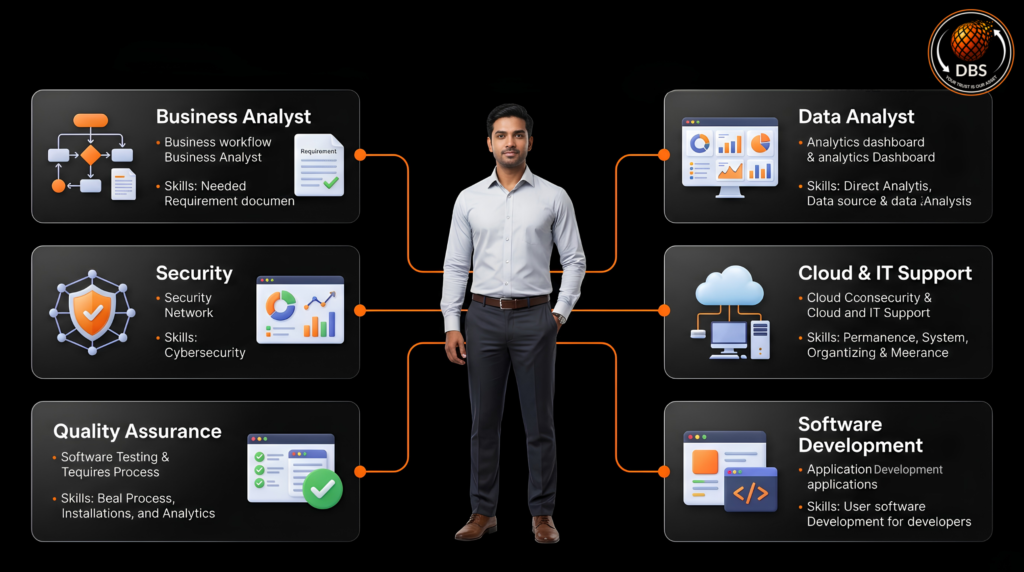
There is no single “best” IT career for everyone.
The right role depends on your interests, existing skills, education, experience and the type of work you want to perform.
Several technology areas continue to receive attention as companies adopt digital systems and automation.
Business Analyst
Business Analysts work between business teams and technology teams.
They help identify business requirements, document processes, communicate requirements and support technology projects.
This can be a relevant path for people who already have communication, process or business experience.
Someone from banking, operations, sales or customer service may already have useful experience in understanding customer needs and business processes.
The missing piece may be learning how those skills apply within technology projects.
Data and Analytics Roles
Businesses generate large amounts of information.
They need professionals who can organise, analyse and communicate data.
Data-related careers can include data analysis, reporting and business intelligence.
These roles often require tools such as SQL and data visualisation platforms.
You do not need to start by learning every advanced data science technique.
A practical foundation in data, databases, SQL and business analysis can provide a starting point for certain entry-level technology roles.
Cybersecurity
Cybersecurity has become a major business concern because companies depend heavily on digital systems.
LinkedIn’s 2026 India coverage identified Cyber Security Specialist as one of its Jobs on the Rise in India.
The field covers areas such as security monitoring, risk management, identity, network security and incident response.
Cybersecurity is not a single skill.
It is a broad field that requires continuous learning because threats and technologies change.
For beginners, understanding operating systems, networks and security fundamentals can provide a foundation for further study.
Cloud and IT Support
Companies increasingly depend on cloud services and digital infrastructure.
IT support professionals help users and organizations solve technology problems.
Cloud and infrastructure roles can involve operating systems, networking, servers, cloud platforms and troubleshooting.
Linux and Unix knowledge can be useful foundations for many technical environments.
For someone who does not want to become a software developer, IT support and infrastructure can provide another possible technology career direction.
Software and Quality Assurance
Software development remains an important technology function.
Quality Assurance is another area within the software lifecycle.
QA professionals test software, identify defects and verify that applications meet requirements.
The U.S. Bureau of Labor Statistics projects continued growth for software developers, QA analysts and testers from 2024 to 2034. This is U.S. data, so it should not be treated as a direct forecast for India’s job market, but it does illustrate continued demand for software-related work in a major technology market.
Can Non-IT Professionals Still Enter IT?
A non-IT background does not automatically prevent someone from building an IT career.
The important question is whether you can demonstrate relevant skills for the role you are targeting.
Someone working in BPO, KPO, banking, healthcare, insurance, sales or operations may already have valuable workplace skills.
You may already understand:
- Customer communication
- Business processes
- Documentation
- Problem-solving
- Team collaboration
- Reporting
- Process management
- Handling deadlines
- Working with business systems
The next step is connecting those skills with technology.
For example, someone with banking experience could explore technology roles connected with financial services.
Someone with customer support experience could explore IT support.
Someone with business experience could explore Business Analyst roles.
The career change becomes more practical when you stop trying to become “an IT professional” in general and start preparing for a specific role.
You Do Not Need to Become a Programmer
One common misconception is that entering IT means learning advanced programming.
Programming is an important IT skill, but IT contains many career paths.
Business Analysis, IT support, QA, cybersecurity, data analysis and project-related technology roles can involve different levels of coding.
The correct approach is to identify the job you want and learn the technical skills that role actually requires.
For a beginner, learning practical concepts can be more useful than trying to learn ten programming languages at once.
Linux, Unix, SQL, databases, business analysis and basic technology concepts can provide useful foundations depending on the career path.
Transferable Skills Can Become IT Skills
Career changers often underestimate what they already know.
A BPO professional may understand customer processes.
A banking professional may understand financial workflows.
A healthcare professional may understand operational processes.
A sales professional may understand customer requirements and communication.
These experiences can become useful when combined with technology skills.
The goal is not to erase your previous career.
The goal is to connect your previous experience with a new technology-focused role.
What Skills Should You Learn for an IT Career in 2026?
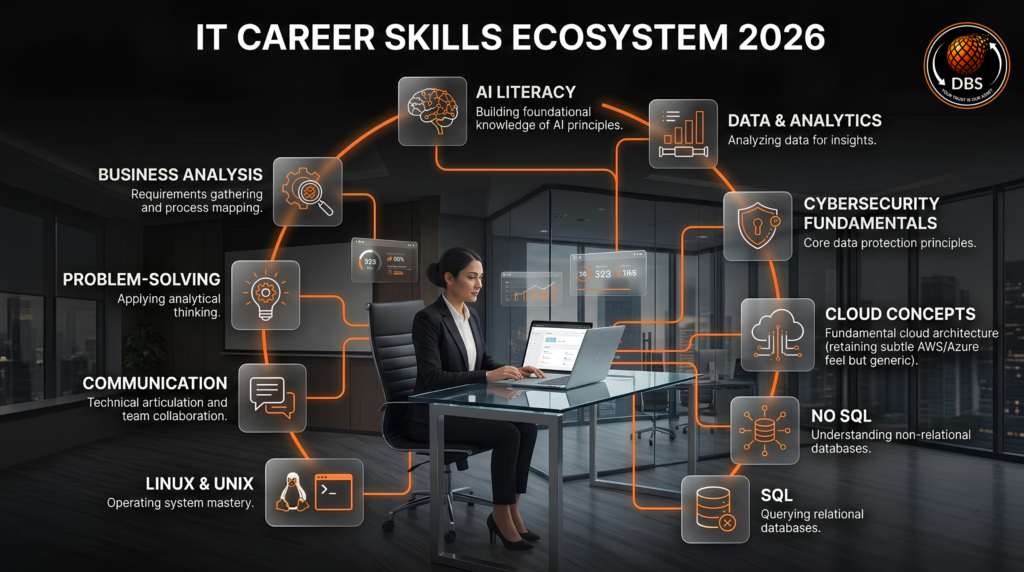
Start with the role, not the course.
If you want to become a Business Analyst, focus on requirements, business processes, documentation, communication, data and technology concepts.
If you want to explore IT support, focus on operating systems, troubleshooting, networking and infrastructure fundamentals.
If you want to move toward data roles, learn databases, SQL, analysis and reporting.
If you want to explore cybersecurity, build a foundation in operating systems, networks and security concepts.
The World Economic Forum’s research highlights AI and big data, networks and cybersecurity and technology literacy among the skills expected to grow in importance through 2030.
But technical skills are only one part of the equation.
Employers also value communication, problem-solving, adaptability and the ability to learn.
A strong 2026 skill set therefore combines:
- Technology fundamentals
- Role-specific technical skills
- Business understanding
- Communication
- Problem-solving
- Practical experience
- Interview readiness
- Continuous learning
Do not try to learn everything.
Learn what your target role requires.
Then practise it.
Then learn how to explain it during an interview.
How Digital Business Solutions IT Can Help You Move From Non-IT to IT
Digital Business Solutions IT is designed for professionals and graduates who want to move from non-IT backgrounds into technology careers.
The focus is practical learning rather than simply completing theoretical lessons.
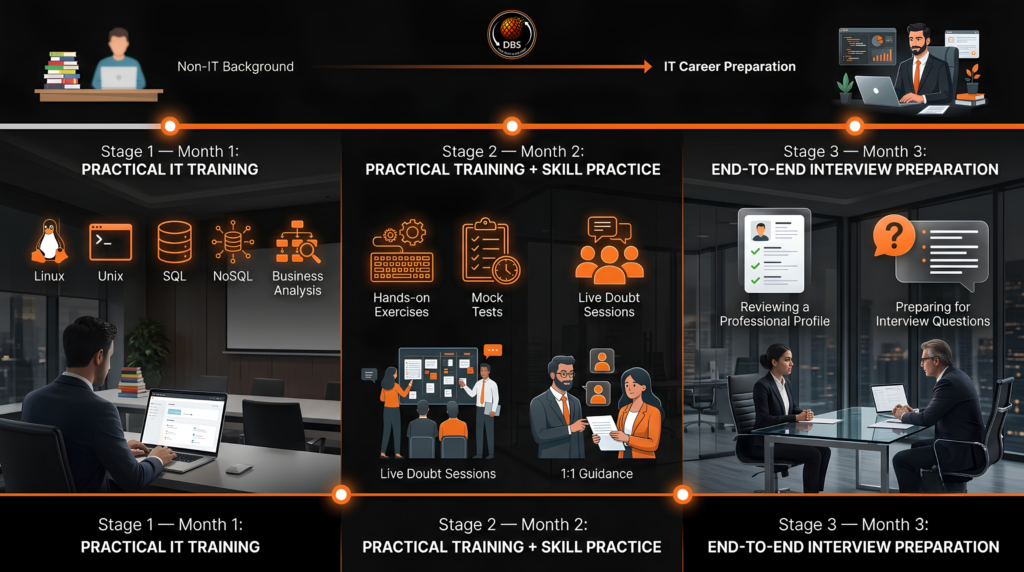
The program runs for 3 months.
The first 2 months focus on practical training.
This includes topics such as Linux, Unix, SQL, NoSQL and Business Analysis, depending on the selected learning path.
Students also get:
- Practical training
- Mock tests
- Live doubt sessions
- 1:1 guidance
- Career-focused learning support
The objective is to help learners understand how technology concepts work in practical situations.
The third month focuses on end-to-end interview preparation.
This matters because learning a skill and getting hired are two different stages.
A candidate may understand a concept but struggle to explain it in an interview.
Interview preparation helps candidates practise how to present their knowledge, answer questions and communicate their experience clearly.
Months 1–2: Practical IT Training
The first two months focus on building practical technology knowledge.
Instead of expecting a beginner to understand everything immediately, the learning process can break concepts into manageable areas.
Topics can include Linux, Unix, SQL, NoSQL and Business Analysis.
Learners also receive live doubt sessions and 1:1 guidance.
Mock tests provide an opportunity to check understanding before moving to interview preparation.
This structure can be particularly useful for professionals who are starting from a non-IT background and need a clear learning path.
The goal is to move from “I have never worked in IT” toward “I understand the skills required for the role I am targeting.”
Month 3: End-to-End Interview Preparation
Technical learning is only part of a career transition.
The third month focuses on interview preparation from beginning to end.
This can include mock interviews, interview questions, profile preparation, communication practice and guidance on presenting your skills.
The objective is to help candidates become more comfortable discussing what they have learned.
For a career changer, this stage is important because interviewers may ask why the candidate moved from a non-IT field into technology.
A clear career story matters.
Your previous experience, newly developed IT skills and target role should connect logically.
Is Switching to IT Worth It in 2026?
There is no universal answer because a career change depends on your goals, current career, financial situation, interests and willingness to learn.
But the data does show that technology continues to influence the labour market.
The World Economic Forum expects technology-related roles and skills to remain important through 2030.
AI is changing how work is performed.
Cybersecurity requirements are increasing as businesses become more digital.
Cloud, data, software and business technology continue to support organizations.
That means the question should not simply be:
“Is IT still good?”
A better question is:
“Which IT career matches my strengths, and what skills do I need to become employable in that role?”
That question leads to a more useful career plan.
If you are from a non-IT background, you do not have to learn every area of technology.
Choose a realistic role.
Learn the required skills.
Practise them.
Build a professional profile.
Prepare for interviews.
Keep learning after you enter the industry.
Final Takeaway: IT Is Changing, Not Disappearing
The IT industry of 2026 is different from the IT industry of the past.
AI is changing tasks.
Automation is changing workflows.
Cloud technology is changing infrastructure.
Cybersecurity is becoming increasingly important.
Data is influencing business decisions.
But technology itself is not disappearing.
The people who benefit from this changing environment will need to keep learning and adapt their skills to new ways of working.
For non-IT professionals, this does not mean starting from zero.
Your existing professional experience can remain valuable when combined with relevant technology skills.
If your goal is to move from non-IT to IT, start with one target role rather than trying to learn everything.
Digital Business Solutions IT offers a structured 3-month program, with 2 months of practical training and 1 month of end-to-end interview preparation, including mock tests, live doubt sessions and 1:1 guidance.
The bigger goal is simple:
Learn the right skills. Build practical confidence. Prepare for the interview. Then take your next career step.
IT in 2026 is not the same career it was yesterday.
That is exactly why your skills should not stay the same either.
Take the first step toward your IT career today.
Digital Business Solutions IT — Helping Non-IT Professionals Build Their Future in IT.
Book your free career consultation: https://forms.gle/spZqzEs2WGxepktg6
Watch real stories and career tips on our podcast: https://youtu.be/xlrOIaZTwWI
Follow Digital Business Solutions IT for weekly career tips:
- Instagram: @official_biplob_mandal
- LinkedIn: Biplob Mandal
Call us: +91 9307867881 / +91 7558759407
Email: contactus@digitalbusinesssolutionsforyou.com
Visit us: Office No. 412, 4th Floor, City Space, Digital Business Solutions IT, Pune Nagar Rd, above Aakash Eye Clinic, Viman Nagar, Pune, Maharashtra 411014
- BPO to IT: How to Change Career from BPO to IT Jobs
- How long does it actually take to switch from Non-IT to IT?
- Best Cities in India for a Non-IT to IT Career Switch (2026)
- SQL for Beginners: The One Skill That Opens IT Analyst Jobs
- What i wish I knew before switching from Non-IT to IT
- Top 10 Interview Questions for Non-IT to IT Career Switchers (and How to Answer Them)
- How to Write an IT Resume When You Have Zero IT Experience
Frequently Asked Questions
1. Is IT still a good career in 2026?
Yes, IT remains a major career field in 2026, but the skills employers need are changing. AI, cloud computing, cybersecurity, data, software and business technology continue to shape the industry. Professionals who combine relevant technical skills with communication and problem-solving can explore different IT career paths.
2. Will AI replace IT jobs in 2026?
AI is automating some repetitive tasks and changing how many IT professionals work. However, technology businesses still need people to understand requirements, solve problems, manage systems, test applications, analyse information and make decisions. The focus is increasingly shifting toward professionals who can work effectively with AI and other technologies.
3. Can a non-IT professional get an IT job in 2026?
Yes. Non-IT professionals can move into IT by identifying a suitable role and developing the skills required for it. Previous experience in banking, BPO, KPO, healthcare, insurance, sales or operations can also provide transferable business and communication skills.
4. Can I switch from non-IT to IT without coding?
Yes, some IT career paths do not require advanced programming. Business Analysis, IT support, QA, certain data roles and other technology-related positions can have different coding requirements. The skills you need depend on the specific role you choose.
5. Which IT careers are suitable for non-IT professionals?
Potential paths include Business Analyst, IT Support, QA, Data Analyst and some cybersecurity or cloud-related entry-level roles. The right option depends on your existing experience, interests and the skills you are willing to learn.
6. Do I need a technical degree to start an IT career?
A technical degree can be useful for certain roles, but it is not the only way to develop technology skills. Some IT roles place greater emphasis on practical skills, relevant knowledge, communication and role-specific experience. Requirements vary by employer and position.
7. What IT skills should I learn in 2026?
Start with skills related to your target role. Depending on the career path, these may include SQL, Linux, Unix, databases, Business Analysis, cybersecurity fundamentals, cloud concepts, data analysis or software testing. Communication and problem-solving are also important workplace skills.
8. How long does it take to prepare for an IT career?
The time required varies according to your background, target role and learning pace. A structured program can help create a clear learning path. Digital Business Solutions IT offers a 3-month program with 2 months of practical training followed by 1 month focused on end-to-end interview preparation.
9. What does Digital Business Solutions IT teach?
Digital Business Solutions IT provides practical training designed for people looking to move from non-IT to IT. Depending on the learning path, topics include Linux, Unix, SQL, NoSQL and Business Analysis, along with mock tests, live doubt sessions and 1:1 guidance.
10. Does Digital Business Solutions IT provide interview preparation?
Yes. The third month of the program focuses on end-to-end interview preparation. This follows the first two months of practical training and is designed to help learners prepare for the transition from learning IT skills to presenting those skills during interviews.
11. Is IT a good career choice for working professionals?
IT can be one option for working professionals who want to change careers, but the decision depends on individual goals and circumstances. Professionals can build on their existing industry experience while developing technology skills relevant to a target IT role.
12. Is it too late to switch to IT in 2026?
There is no fixed age at which a career change becomes impossible. Working professionals can consider an IT transition by assessing their existing skills, choosing a realistic target role and building the required technical knowledge. A structured learning and interview-preparation plan can make the process more organised.