Layoffs in Tech: Why Non-IT to IT Switchers Are Actually Safer Than You Think
Tech layoffs are no longer a distant headline.
They have become a serious concern for people planning their careers.
If you are working in BPO, KPO, banking, finance, healthcare, operations or another non-IT field, you may be asking:
“Why should I switch to IT when technology companies themselves are laying people off?”
That is a reasonable question.
Technology companies have announced significant workforce reductions. Challenger, Gray & Christmas reported that technology companies announced 149,023 job cuts through July 2026, making technology the largest source of announced cuts among the industries it tracks.
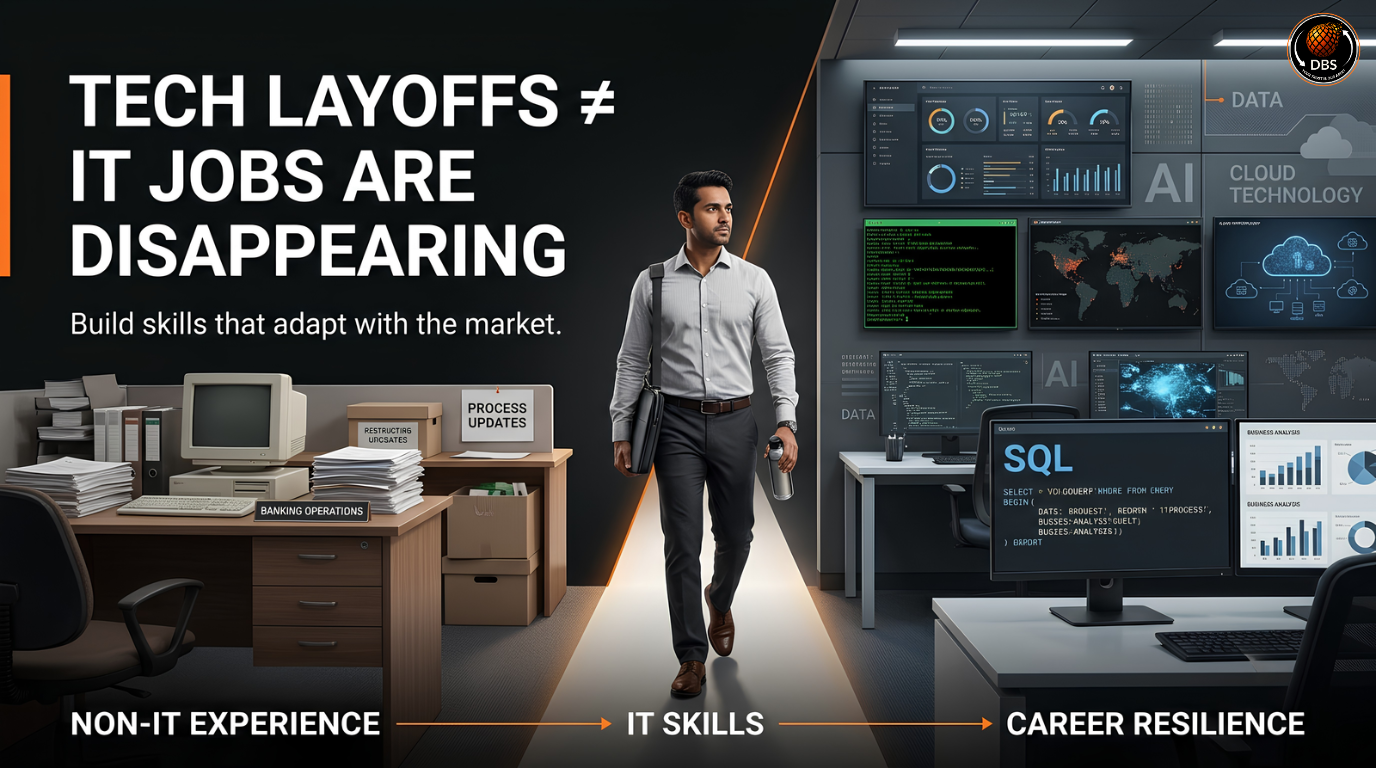
At the same time, the IT job market is not disappearing.
The U.S. Bureau of Labor Statistics projects strong employment growth for several technology occupations between 2024 and 2034, including software developers and information security analysts.
The World Economic Forum also identifies AI and big data, networks and cybersecurity, and technological literacy among the fastest-growing skill areas through 2030.
So the real question is not:
“Is IT safe from layoffs?”
No industry can make that guarantee.
The better question is:
“How can I build an IT career that remains useful when companies, tools and job requirements change?”
That is where non-IT professionals may have an important advantage.
A career switcher can enter IT with something many early-career candidates have not yet developed: experience with customers, business processes, communication, operations, documentation, problem-solving and workplace realities.
Add practical technology skills to those existing abilities, and the result can be a broader professional profile.
1. Tech Layoffs Are Real — But They Do Not Mean Technology Jobs Are Disappearing
The first mistake is treating layoffs and job growth as opposites.
They are not.
Companies can reduce headcount in one area while increasing hiring in another.
They can eliminate repetitive work while investing in cybersecurity.
They can reduce certain software roles while increasing spending on AI infrastructure, data, cloud systems or automation.
This is exactly why looking only at layoff headlines can create an incomplete picture.
Technology companies are changing what they hire for
The current technology market is being shaped by several forces:
- Artificial intelligence
- Automation
- Cloud computing
- Cybersecurity
- Data
- Digital transformation
- Cost reduction
- Business process improvement
The World Economic Forum expects technology-related skills to rise rapidly through 2030.
AI and big data rank among the fastest-growing skills, followed by networks and cybersecurity and technological literacy.
This does not mean every IT role will grow.
It means the composition of technology work is changing.
Some repetitive tasks may require fewer people.
Other tasks may require people who understand systems, business requirements, data, security, quality and technology together.
That distinction matters for someone switching into IT.
The goal should not be to learn one software tool and assume that it guarantees employment.
The goal should be to develop a skill combination that remains useful even when individual tools change.
2. Why Non-IT Professionals Can Bring More Than Technical Skills
A career switcher often thinks their previous experience becomes irrelevant after entering IT.
That is a mistake.
Your previous career can become part of your IT profile.
Someone coming from banking may understand financial processes, customer documentation and compliance.
Someone from healthcare may understand patient workflows and sensitive information.
Someone from BPO may understand customer communication, escalation handling and service processes.
Someone from operations may understand workflows, reporting, coordination and process improvement.
These experiences can become useful when combined with technology skills.
Business knowledge can become an IT advantage
Technology exists to solve business problems.
That means IT teams need people who can understand both sides.
Consider a Business Analyst.
The role is not simply about knowing software.
It involves understanding a business problem, gathering requirements, communicating with stakeholders, documenting processes and helping technology teams translate business needs into workable solutions.
A person who already understands workplace processes may have useful experience to build on.
The same principle applies to roles involving data, quality assurance, IT support, project coordination and technology operations.
The career switch therefore does not always mean starting from zero.
It can mean combining two sets of capabilities.
Previous industry knowledge + technology skills = broader professional value.
3. The Biggest Career Risk Is Depending on One Skill
Layoffs are often discussed as though the main question is which industry is safe.
A more useful question is whether your skills can move with you.
Suppose your entire professional value depends on one software tool.
If the company changes that tool, automates the process or moves to another platform, your value may be affected.
Now compare that with someone who understands:
- Business requirements
- Data
- SQL
- Documentation
- Process analysis
- Communication
- Problem-solving
- Basic systems
- AI-assisted workflows
That person has multiple ways to apply their knowledge.
Build a skill stack instead of a single skill
A skill stack combines several complementary abilities.
For example:
SQL + Business Analysis + Communication
or
Linux + IT Support + Troubleshooting
or
Data Analysis + Business Understanding + Presentation
or
Cybersecurity fundamentals + Networking + Risk awareness
A skill stack does not make someone immune to layoffs.
It creates more ways to contribute and potentially more directions to pursue when the market changes.
This is particularly useful for non-IT professionals because their existing experience can become one layer of the stack.
4. IT Is Much Bigger Than Software Development
Many people hear “IT” and immediately imagine programming.
That creates unnecessary fear.
Software development is one part of technology.
The wider IT ecosystem includes areas such as:
- Business Analysis
- Data Analysis
- Quality Assurance
- IT Support
- Cybersecurity
- Cloud Operations
- Database Administration
- Project Management
- Systems Administration
- Technical Support
- IT Operations
The education and skill requirements differ by role.
A person switching careers should therefore start by identifying the type of technology work that fits their existing strengths.
Choose the role before choosing the course
Instead of asking:
“Which IT course should I do?”
start with:
“What type of IT work do I want to perform?”
If you enjoy understanding business problems, Business Analysis may be worth researching.
If you enjoy numbers and patterns, Data Analysis may be relevant.
If you enjoy troubleshooting systems, IT Support or infrastructure roles may fit better.
If security interests you, cybersecurity provides another direction.
The course should follow the career target.
Not the other way around.
5. Technology Skills Can Make Existing Experience More Valuable
A career switch does not always require abandoning everything you already know.
In many cases, the stronger strategy is to connect your previous experience with new technology skills.
Imagine a banking professional who learns SQL and Business Analysis.
They are not simply becoming “a fresher in IT.”
They are adding technology capabilities to an existing understanding of financial operations.
A BPO professional who develops SQL, reporting and technology support skills may combine customer experience with technical problem-solving.
An operations professional who learns Business Analysis can connect process knowledge with technology requirements.
This combination can help create a more differentiated professional profile.
The goal is not to erase your past career
Your previous work can provide context.
Your new technology skills provide another layer.
Together, they can support career paths that sit between business and technology.
This is increasingly important because companies do not operate through technology teams alone.
Technology affects finance, healthcare, retail, banking, manufacturing, logistics, insurance and almost every other major business sector.
That means IT skills can be applied outside traditional technology companies.
6. AI Changes the IT Job Market — It Does Not Remove the Need for IT Skills
AI is one of the biggest reasons people are nervous about entering technology.
That concern is understandable.
Companies are already using AI to automate tasks, increase productivity and redesign workflows.
Challenger, Gray & Christmas reported that AI was cited as the leading reason for announced job cuts during several months of 2026.
But AI is also increasing demand for people who can implement, manage, test, secure and use technology effectively.
AI makes technological literacy more important
The World Economic Forum lists technological literacy among the fastest-growing skills.
That matters even for professionals who do not become AI engineers.
A Business Analyst may use AI to organize requirements.
A data professional may use AI to accelerate analysis.
An IT support professional may use AI-assisted troubleshooting.
A cybersecurity professional may use AI tools for monitoring and investigation.
The important distinction is between being replaced by a tool and becoming more productive with a tool.
The second outcome is increasingly becoming part of modern work.
Therefore, learning IT today should include learning how AI changes the work rather than pretending AI does not exist.
7. Transferable Skills Matter More During Career Change
Technical knowledge gets attention because it is easy to list on a resume.
But companies also need people who can think, communicate and solve problems.
The World Economic Forum’s Future of Jobs Report 2025 identifies analytical thinking as the top core skill reported by employers.
Resilience, flexibility and agility also rank highly.
These are skills that many non-IT professionals have already developed through years of workplace experience.
Your previous job may have built valuable skills
Consider what your current job has already taught you.
You may know how to:
- Handle difficult customers
- Work under deadlines
- Follow processes
- Prepare reports
- Coordinate with teams
- Explain problems
- Escalate issues
- Manage documentation
- Track performance
- Understand business workflows
These abilities do not disappear when you move into IT.
The opportunity is to connect them with technology.
That can make the transition more practical than trying to become a completely different professional overnight.
8. Job Security Comes From Adaptability, Not From a Job Title
There is no permanently safe job title.
A role that is in high demand today can change tomorrow.
A technology that is popular today can be replaced by another platform.
A company that is growing today can restructure later.
This is why career resilience matters more than chasing a supposedly “safe” designation.
Learn how to keep learning
A resilient IT professional should be able to:
- Learn new tools
- Understand changing business needs
- Use AI responsibly
- Communicate with different teams
- Solve unfamiliar problems
- Update technical knowledge
- Demonstrate measurable work
The World Economic Forum estimates that a significant share of workers’ existing skills will change or become outdated between 2025 and 2030.
That makes continuous learning a practical career requirement.
The objective is not to study forever.
It is to remain capable of learning what the job requires next.
9. Non-IT to IT Does Not Mean Starting From Zero
One of the biggest mental barriers is the belief that a career switcher is automatically behind a computer science graduate.
That comparison is too simple.
A computer science graduate may begin with stronger formal technical foundations.
A working professional may begin with stronger business experience, communication skills and knowledge of a particular industry.
Both can have gaps.
Both can build new skills.
The starting point is simply different.
Build from what you already know
A practical transition can follow this structure:
Step 1: Identify your transferable strengths
Look at your current work and identify the processes, communication skills and business knowledge you already possess.
Step 2: Choose a realistic IT direction
Research roles based on responsibilities, required skills and entry requirements.
Step 3: Learn the technical foundation
Focus on the technologies directly connected to your target role.
Step 4: Practice
Complete practical tasks instead of only watching lectures.
Step 5: Build evidence
Projects, case studies, assessments and practical demonstrations can show what you can actually do.
Step 6: Prepare for interviews
Learn how to explain both your previous experience and your new technology skills.
This creates a career story that connects the old role to the new one.
10. The IT Roles Worth Researching Are Not All the Same
There is no single “best” IT career for every non-IT professional.
Different roles require different combinations of skills.
Here are several areas worth researching.
Business Analyst
Business Analysts connect business requirements with technology solutions.
Relevant skills can include requirements gathering, process mapping, documentation, stakeholder communication and tools used for analysis.
A professional with prior business-process experience may find the connection between existing knowledge and new IT skills particularly relevant.
Data Analyst
Data-focused roles involve working with information to identify patterns and support decisions.
SQL, spreadsheets, data visualization and analytical thinking are commonly relevant.
People who already work with reports, numbers or operational data may have useful foundations to build on.
IT Support
IT support focuses on helping users and maintaining technology operations.
Troubleshooting, operating systems, networking fundamentals, documentation and communication are important areas.
Strong customer-service experience can be useful when combined with technical training.
Cybersecurity
Cybersecurity focuses on protecting systems, networks and information.
Networking, security concepts, monitoring, risk awareness and continuous learning are important.
It is a field where technology changes quickly, making ongoing learning particularly important.
Quality Assurance
Quality Assurance involves testing software and identifying problems before products reach users.
Attention to detail, logical thinking, documentation and communication are valuable.
Depending on the role, testers may work with both manual testing and automation tools.
11. How to Make Your Career Switch More Resilient
Switching careers is only the first step.
The next goal is building a profile that can adapt.
Start with fundamentals.
Do not collect dozens of certificates without being able to demonstrate practical ability.
Build practical technology skills
Depending on the target role, useful foundations may include:
- SQL
- Linux
- Databases
- Business Analysis
- Networking
- Data analysis
- Cloud fundamentals
- Cybersecurity fundamentals
- Testing
- AI-assisted productivity
The correct combination depends on the job.
Depth in relevant skills is more useful than a long list of unrelated technologies.
Learn to show your work
Recruiters and interviewers need evidence.
Instead of saying:
“I know SQL.”
be ready to explain what you used SQL to solve.
Instead of:
“I understand Business Analysis.”
be prepared to discuss a requirement, process or case study you worked through.
Practical evidence turns a skill claim into something easier to evaluate.
12. What Non-IT Professionals Should Not Do
Fear of layoffs can cause people to make poor career decisions.
Avoid these common mistakes.
Do not switch because of hype
A job title appearing frequently on social media does not automatically make it suitable for you.
Research the actual work.
Do not chase every new AI tool
Tools change quickly.
Fundamental skills remain more transferable.
Learn how the technology works and where it creates business value.
Do not assume one certificate guarantees a job
Certificates can support learning.
They cannot replace practical ability, communication, interview preparation and relevant experience.
Do not hide your previous career
Your previous experience can strengthen your story.
Explain how it connects to the IT role you are targeting.
Do not expect zero risk
IT has layoffs.
Other industries have layoffs too.
Career resilience comes from maintaining relevant skills and being able to adapt when conditions change.
13. A Simple Career Resilience Framework for IT Switchers
Think about your career as four layers.
Layer 1: Previous experience
Your industry, workplace and business knowledge.
Layer 2: Technology skills
The practical IT capabilities required for your target role.
Layer 3: Human skills
Communication, analytical thinking, collaboration and problem-solving.
Layer 4: Adaptability
Your ability to learn new tools and respond to changing business requirements.
A strong career profile connects all four.
Example
Imagine someone with five years of banking experience.
Their profile could develop from:
Banking operations
to:
Banking operations + SQL
to:
Banking operations + SQL + Business Analysis
to:
Business Analysis + financial-domain knowledge + AI-assisted productivity
The person has not erased their previous career.
They have expanded it.
That is the real idea behind a resilient career switch.
14. So, Are Non-IT to IT Switchers Actually Safer?
Not automatically.
No honest career article can promise that a non-IT professional will avoid layoffs after moving into technology.
The evidence does not support such a guarantee.
Technology is experiencing both job cuts and job creation.
Some technology roles are under pressure from automation and restructuring.
At the same time, employment projections show continued growth in several technology occupations, while global employer surveys indicate rising demand for technology skills.
The more useful conclusion is this:
A non-IT professional can potentially build a resilient IT career by combining previous work experience with relevant technology skills, business knowledge and continuous learning.
That combination can create more career options than relying on a single job title.
The real advantage is the combination
Your previous career gives you context.
Technology skills give you new opportunities.
Business knowledge helps you understand why technology is being used.
Human skills help you work with people.
Adaptability helps you respond when the market changes.
None of these guarantees job security.
Together, however, they can create a stronger foundation for handling change.
15. Should You Switch From Non-IT to IT in 2026?
If layoffs are the only reason you are avoiding IT, it is worth looking at the complete market rather than one headline.
Ask yourself five questions:
- What problems do I enjoy solving?
- Which of my current skills can transfer to technology?
- Which IT roles match my existing experience?
- What technical skills does that role actually require?
- Can I demonstrate those skills through practical work?
If you can answer these questions clearly, the decision becomes much more practical.
You do not need to predict which technology will dominate five years from now.
You need to build skills that allow you to learn and contribute as technology changes.
Final Takeaway
Tech layoffs are real.
AI is changing technology work.
Some roles will shrink, some will change and others will grow.
But that does not mean entering IT is automatically a bad career decision.
For a non-IT professional, the strongest approach is not to chase the promise of a “layoff-proof” job.
It is to build a combination of:
Industry experience + practical IT skills + business understanding + human skills + adaptability.
That is a much more realistic definition of career security.
The question is no longer simply:
“Is IT safe?”
A better question is:
“Am I building skills that remain useful when IT changes?”
That is the mindset that can turn a career switch into a long-term professional strategy.
Digital Business Solutions IT — Empowering Non-IT Professionals to Build Their Future in IT.
Take the first step toward your IT career today.
Digital Business Solutions IT — Helping Non-IT Professionals Build Their Future in IT.
Book your free career consultation: https://forms.gle/spZqzEs2WGxepktg6
Watch real stories and career tips on our podcast: https://youtu.be/xlrOIaZTwWI
Follow Digital Business Solutions IT for weekly career tips:
- Instagram: @official_biplob_mandal
- LinkedIn: Biplob Mandal
Call us: +91 9307867881 / +91 7558759407
Email: contactus@digitalbusinesssolutionsforyou.com
Visit us: Office No. 412, 4th Floor, City Space, Digital Business Solutions IT, Pune Nagar Rd, above Aakash Eye Clinic, Viman Nagar, Pune, Maharashtra 411014
- BPO to IT: How to Change Career from BPO to IT Jobs
- How long does it actually take to switch from Non-IT to IT?
- Best Cities in India for a Non-IT to IT Career Switch (2026)
- SQL for Beginners: The One Skill That Opens IT Analyst Jobs
- What i wish I knew before switching from Non-IT to IT
- Top 10 Interview Questions for Non-IT to IT Career Switchers (and How to Answer Them)
- How to Write an IT Resume When You Have Zero IT Experience